Sarah Bird is one of the relatively few female leaders in the local tech industry, serving as CEO of Moz, a Seattle-based outfit that helps businesses build up their online presence. And the company’s gender equity doesn’t stop at the top: while, on average only 29 percent of employees at American tech firms identify as female, a whole 40 percent of “Mozzers” are women.
That seems laudable. But Bird sees it differently. “Our gender diversity numbers are still terrible,” she wrote in the 2015 company report.
Bird has emerged as one of the state’s top advocates for achieving a greater gender balance in tech – within her company, at the state legislature in Olympia, and even at the White House. In her eyes, it is an ethical imperative.
Happy Spring Friends and Colleagues! Here’s a recap of the 2016 legislative session and tips on how YOU can help advance policy for Washington women and families in the coming months.
Legislative Recap
The 60-day legislative session ended on March 10th. Despite early hopes, in the end, outcomes were disappointing. You can read more about how our three priorities (Family and Medical Leave Insurance, Equal Pay and Pregnancy Accommodations) fared in Olympia in the context of Women’s History Month in Marilyn’s blog
Take Action During The Election
If you’re feeling as disappointed as we are with our progress so far this year — then get busy! It is election season after all, and you have the chance to make a difference in who will represent you in Olympia in 2017. The most important thing you can do: Ask your candidates where they stand!
This link leads you to questions you can ask at candidate forums, legislative meetings, community events and legislative district meetings. If you are pleased (or not pleased) with the response, post on our Facebook page, and let us know if candidates need follow-up information.
The most exciting initiative of the season
Raise Up Washington is leading the effort on Initiative 1433, by far the most exciting state ballot initiative of the season. It will allow all workers in the state to earn paid sick leave, and increase the minimum wage in 4 steps to $13.50 by 2020!
The campaign is running a volunteer only (!) signature gathering effort to collect over 250,000 signatures by the beginning of summer. YOU can help! Use this linkto volunteer to gather signatures, or contact Samantha at Raise Up Washington: 206-709-1313 (office) or 206-595-4668 (mobile).
While women in other states can celebrate recent strides toward equality, here in Washington our state Legislature marked Women’s History Month by closing down its 2016 regular session on March 10 with bills attacking gender inequity…dead in their tracks.
Progress was within reach – even given the partisan divide between the House (Democrat) and Senate (Republican). After all, bills to strengthen equal pay protections and ensure pregnant women could ask for reasonable accommodations at work (like bathroom breaks and a stool to sit on) had passed with bipartisan support in other states. Surely similar bills would have a chance in Washington, in an election year no less!
At first, prospects looked promising. The Equal Pay and Opportunities Act passed Washington’s House 56 to 41, with six Republicans joining all the Democrats. It would have assured workers could discuss pay without retaliation and closed loopholes that allow some employers now to get away with discriminatory pay and hiring practices.
But when the bill moved to the Senate, Republican leadership kept the name and stripped out worker protections, replacing them with new protections for employers to impose wage secrecy. The amended bill, if passed, could score points with voters even as it limited worker rights for the benefit of corporate interests. Fortunately, the three Democrats on the Commerce and Labor Committee – Senators Hasegawa, Conway, and Keiser – refused to go along, and the bill died.
Versions of a Pregnant Workers Fairness Act passed both the Houseand Senate. But the Senate bill excluded all nonprofit employers – including big hospitals and other major organizations that employ large numbers of women, often in long, physically demanding shifts. When the House fixed that and other shortcomings, the Senate refused to concur, so that bill died, too.
Meanwhile, the FAMLI Act failed to even get a committee hearing. It would have created a system modeled after successful programs in other states to provide all workers with up to twelve weeks of paid leave for the birth or adoption of a child, care of a seriously ill family member, or for the worker’s own serious health condition.
The Legislature did manage to send a bill to the Governor that will create a new rape kit tracking system – but only after removing the funding that would have actually allowed for testing those kits.
We could get discouraged – but let’s get busy instead.
When the first women’s rights convention was held in Seneca Falls, NY in 1848, women didn’t have the right to vote, pursue diverse professions, control property or make decisions about their children’s welfare if married. They didn’t win those rights by politely asking for them or giving up after a few tries.
Women and male allies organized, marched, petitioned, practiced civil disobedience, and went on strike. They faced ridicule, arrest, and physical violence. In fact, Women’s History Month itself has itsroots in a 1908 strike by women garment workers in New York City, who demanded better working conditions, an end to child labor, and the right to vote.
When women won the vote in 1920, many believed full equality was close at hand. The first female Cabinet member, Frances Perkins, who served as Secretary of Labor from 1933-1945, helped establish key policies that still provide a firm foundation for millions of working men and women today: the minimum wage, overtime, Unemployment Insurance, and Social Security.
During World War II, women joined the workforce in droves – and Washington state passed its first Equal Pay law. But during the 1950s and ‘60s, employers still openly practiced sexual and racial discrimination in hiring. Professional schools limited the number of women in each class. And schools rarely offered girls’ sports. The notion that women had innately different skills and abilities, and simply were not suited to male pursuits, seemed to prevail.
It took a whole new women’s movement, and another round of equal pay and equal opportunity legislation, to open career and educational choices that have brought us to today, where women earn the majority of college and graduate degrees and make up half the U.S. workforce.
Still, those gender and racial wage gaps persist. Workplace practices remain stacked against women, and too many of our state’s elected leaders are ignoring and discounting what it takes for workers to provide for their families, and keep themselves and their loved ones healthy.
To make things right, Washington’s women – and their male allies – will have to again stand up, make noise, and demand change.
Althea Gibson became the first African-American and first female African-American tennis player to win a singles title in tennis at Wimbledon in 1957.
Sandra Day O’Connor became the first female justice of the U.S. Supreme Court in 1981. As a justice, O’Connor was as a key swing vote in many important cases, including upholding Roe v. Wade, the Supreme Court decision that legalized abortion. She retired in 2006.
Shirley Chisholm became the first African-American woman elected to Congress in 1969.
Hillary Clinton became the first woman to win a presidential primary contest in 2008.
Frances Perkins became the first woman to serve in a presidential cabinet in 1932.
Tammy Baldwin became the first openly lesbian woman elected to the U.S. Senate in 2012.
Sally Ride became the first American and LGBT woman to enter outer space in 1983.
Nancy Pelosi became the first female Speaker of the House in 2007.
Ella Fitzgerald became the first African-American woman to win a Grammy award in 1959.
Jeannette Rankin became the first woman elected to U.S. Congress in 1916.
Mazie Hirono became the first Asian-American woman elected to the U.S. Senate in 2012.
Madam C.J. Walker became first African-American female self-made millionaire in the early 1900s.
Wilma Mankiller became the first female chief of the Cherokee Nation of Oklahoma in 1985.

 Legislative Recap
 If you’re feeling as disappointed as we are with our progress so far this year — then get busy! It is election season after all, and you have the chance to make a difference in who will represent you in Olympia in 2017. The most important thing you can do:
  The most exciting initiative of the season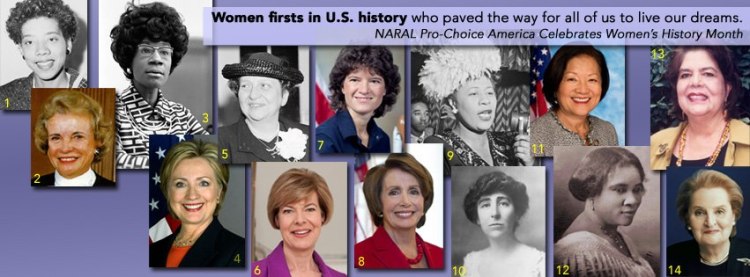
 Washington Work and Family Coalition