Calling on the candidates to debate real family issues

By || USA Today

Denver student Jessica Smith has launched an online petition to urge tonight’s debate moderator, Jim Lehrer, to ask the candidates to explain their positions on family leave, sick time and similar workplace policies – sign it here.

Recently a group of about two dozen care-giving advocates, many of them children’s advocates too, gathered in a conference overlooking K Street to brainstorm about how to make care policies more prominent in the presidential campaign.

There was a universal agreement from the group that the attention to family-friendly public policy issues in this year’s campaign has been non-existent. I witnessed the gathering and found myself nodding my head as one participant after another talked about how care-giving, family leave and workplace flexibility are urgent issues that have somehow been ignored.

It’s a complaint that’s been raised repeatedly in recent months, including by the Post’s Petula Dvorak who railed against the total disregard among political leaders to acknowledge that we have a full-on childcare crisis in this country.

Now comes a new attempt to force this issue on to the stage, specifically onto to the University of Denver stage tonight during the first presidential debate.
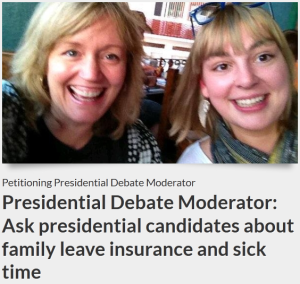
A Denver student named Jessica Smith has launched an online petition to urge the debate’s moderator, Jim Lehrer, to ask the candidates to explain their positions on family leave, sick time and similar workplace policies.

Within hours after Smith posted the petition in late September it received dozens of signatures. By this writing, it was on its way toward gathering 5,000 supporters.

Smith comes to the cause because she has witnessed what our swiss-cheese-like workplace protections can do to parents and children. Smith said when she was 3 years old she suffered a stroke. Her mother had to give up a paycheck and jeopardize her job and health care in order to care for her daughter.

“My mom has told me how she was forced to worry about our family’s finances at a time when I was still in the hospital recovering. Hard-working Americans like my mom shouldn’t be forced to deal with this kind of financial strain when they are caring for sick loved ones. I want our next president to address this problem by supporting paid family leave and paid sick days laws…”

“Presidential candidates can’t talk about strengthening our economy without talking about putting into place these policies that working families need to keep their jobs and pay the bills,” she writes in the introduction to the petition.

A contrarian might say that Smith has a point, but our unsettled foreign policy, dismal economic situation and gaping deficit must take precedence over more mundane domestic issues. I posed this question to Smith.

“Family leave insurance and earned sick days are in themselves economic issue,” she wrote me. “Specifically, economic issues that directly affected my family and affect families all over the country. It’s especially important when the economy is weak; we need to have earned sick days and family leave insurance so that no one has to worry that they are going to be fired for staying home and taking care of a sick child like my mother was.”

Smith added: “I am not surprised the petition is so successful. I knew when we created this petition that family leave insurance and earned sick days affect so many families. If you look at all the comments people have left on the petition with their personal stories you can see these issues are directly affecting families across the country.”

What is surprising, she said, “is that neither candidate has addressed” these issues.

Smith said she has yet to hear from Lehrer. I also sent a query to the PBS NewsHour, over which Lehrer presides, and did not hear back by publication time.

Will Smith venture inside the debate hall to call out a question on the subject herself? Nope, she’ll be outside at a debate rally.

Like many of us, she’ll be watching closely and hoping the notion of family is finally addressed in a substantive way.

Do you think family-friendly policies should be given more attention in the campaigns?

Paid sick leave ordinance means a healthy future for Seattle workers

As summer turns to fall, there’s a bright spot on the horizon: Paid sick days in Seattle. [Photo: Brett Davis, Flickr Creative Commons]
Seattle summers are the best. But with school having just started and fall weather and flu season around the corner, juggling work and family responsibilities will get a little more challenging. There is a bright spot, though: On Sept. 1, a new city ordinance took effect that ensures most workers in Seattle will be able to earn paid sick and safe days, which can be used to care for one’s own illness, a sick child or parent, or to deal with the effects of domestic violence.

Seattle is only the third city in the United States to implement such a measure. It will cover about 150,000 workers who, until now, haven’t had any sick leave. As advocates for the ordinance — and as working mothers with aging parents ourselves — we know the law will have a positive impact on local workers and their families. It will particularly benefit low-wage workers living paycheck-to-paycheck, for whom taking an unpaid sick day is simply not an option.

Many such people work on the front lines of food safety. The Seattle City Council heard from Tasha, a grocery clerk, who detailed the hit her family’s budget takes every time she or one of her children becomes ill, and she has to take unpaid time off. Last year, one in four grocery workers reported working sick because they didn’t have paid sick days. And more than three out of four people employed in restaurants and hotels didn’t have paid sick days.

Paid sick days are also essential for healthy kids and schools. At city council hearings, Seattle school nurse Robin Fleming described the flu sweeping through her schools, with sick children lying in her office for hours because no family member could leave work to pick them up. When parents can take time away from work to care for a sick child, it’s not only better for the child, it helps prevent the spread of disease, keeping us all healthy.

This measure also includes a “safe days” provision for victims of domestic violence and sexual assault. A survivor of violence often needs time off to seek medical attention, find a safe place for family members or pursue legal remedies. Access to paid safe days is critical, because financial independence from an abuser is one of the most important ways a victim can successfully escape the relationship. Paid safe days help ensure workplaces stay safe for survivors’ co-workers, too.

Workers who already have paid leave, either sick leave or a paid time-off policy that combines sick and vacation leave, may not see much change, other than a little more flexibility. Here’s how the policy pencils out:

  • For a business with at least five full-time employees, workers earn up to five days per year.
  • For a business with between 50 to 249 full-time employees, workers earn up to seven days per year.
  • For businesses with more than 250 full-time employees, workers earn up to nine days per year.

Employees started accruing paid sick and safe days just a few days ago, based on the number of hours they work. Part-time and temporary employees, as well as undocumented workers, are covered. New businesses have two years before they need to begin providing paid leave.

The Seattle Office of Civil Rights (SOCR) is responsible for implementing and enforcing the new law. It deserves accolades, both for gathering feedback from local businesses and residents as the final regulations were written, and for reaching out in local neighborhoods to educate workers and business owners about the measure.

Business owners who have questions about implementation, and workers who believe their rights to sick and safe leave have been violated, can learn more about the new law on the city’s website (seattle.gov/civilrights/sickleave.htm) or contact the SOCR.

[From Real Change News, Sep 5, 2012, Vol: 19, No: 36]

Janet Chung works with Legal Voice, a women’s legal advocacy nonprofit, and Gabriela Quintana works with the Seattle Coalition for a Healthy Workforce.

Where do your legislative candidates stand on Family and Medical Leave Insurance?

Every day, thousands of working people in Washington are welcoming a new child, fighting cancer or other serious illnesses, or caring for an aging parent. But most face an impossible choice: return to work, sacrificing family health and well-being – or give up economic security.

Washington’s legislature approved the beginnings of FMLI in 2007, but did not fund it. Now, we’re working on an exciting new proposal to fund FMLI and ensure benefits are available to those caring for sick family members and for taking care of oneself when stricken with cancer or another serious health condition. But we need your help.

Ask your local candidates where they stand on Family Medical Leave Insurance.

From now through the November election, legislative and gubernatorial candidates are participating in candidate forums across the state.  We need your help! Please attend a candidate forum near you. Tell your local candidate that FMLI is important to you, and ask if they will prioritize getting FMLI started. If elected, they will decide whether FMLI can move forward.

We’ve made it easy. We put together a fact sheet with sample questions and information about forums in your local area. Please download it here and help us build economic security for Washington’s working people and families.