How policies for low-wage airport workers can make you sick.

Yoseph Diallo’s dad is the one who encouraged him to look for work at Sea-Tac airport, based on stories his family had heard over the years about stable, good-paying jobs with decent benefits.
So the 19-year-old was happy to get a job last year as a “ramper,” handling and driving baggage from planes to other parts of the airport. But the reality turned out to be quite different than the reputation from years gone by.
A new report by Puget Sound Sage shows that ground service workers at Sea-Tac airport—the majority of whom are people of color, immigrants, and refugees—make substantially less than their counterparts at other West Coast airports, do not have paid sick leave and have filed numerous complaints with the state about poor training and unsafe working conditions.

The group includes cabin cleaners who disinfect tray tables and look for suspicious cargo left behind, wheelchair assistants who shuttle elderly travelers, skycaps and baggage handlers, and other ramp workers who perform functions such as guarding equipment, refueling planes and removing ice. On average, their minimum compensation at Sea-Tac is nearly $4 to $6 less than airport workers doing comparable jobs in Los Angeles, Oakland, San Jose and San Francisco.
These low-wage workers at Sea-Tac are overwhelmingly people of color, according to surveys that have shown the airport’s contractor workforce is only 36 percent white (compared with 64 percent for all of King County and 43 percent for all airport jobs). And the airport has become an employment magnet for newly arrived immigrants and refugees. As many as half of job applications come from transplants from Asia, Africa, Latin America and Eastern Europe.
On principle, everyone—especially people who have had to flee their home countries and may have little frame of reference for how things are supposed to work here—deserves fair working conditions. But this isn’t just about airport workers. It’s about anyone who boards a plane and the policies that shape whether the employees charged with protecting their health and safety are given the tools to do so.

It’s not just the germy kid sitting behind you
For people who are making barely above minimum wage, missing a day of work can mean the difference between making rent that month or not. The lack of paid sick time is a powerful incentive to go to work even when you’re ill, as Diallo has done. Those infected workers then touch the same baggage handles that people will grab straight off the conveyor belt. They can spread germs on tables that the next planeload of people will eat from. They may assist elderly people and others whose immune systems may be compromised.
Diallo, who works the overnight shift at Sea-Tac and attends Highline Community College, says it’s not just about losing the income when he’s sick. When he misses a shift, he says, a point is deducted from his attendance record. If he hits 16 points, Diallo says he’s been told he’ll be fired.
It’s just so hard. It’s really hard. I want to stay home and rest up and try to make sure I don’t get anyone else sick, and I end up having to go to work because I’m afraid to stand up to my managers and tell them my situation. They seem to just not want to listen.
Diallo doesn’t work for the Port of Seattle (which operates Sea-Tac) or Alaska Airlines, whose bags he handles. He works for one of the many contractors that have become increasingly important to Sea-Tac’s operation as the airport and airlines have sought to cut labor costs. For instance, when Alaska Airlines outsourced its ramp operations to Menzies Aviation in 2005, the average wage for those workers fell by more than $5 an hour, according to Puget Sound Sage.
In November of last year, more than 50 workers who perform ground-based services for a variety of contractors filed complaints with the Washington Department of Labor and Industries. They include allegations of exposure to toxic chemicals, denial of bathroom breaks or access to water, exposure to faulty fueling equipment, and lack of training. Here’s a quote from one complaint filed by a wheelchair attendant:
If a passenger was to [relieve him or herself] in my chair, I would just take it to the restroom and clean it with napkins and soap and then continue to use my chair, management has never told me what to do with that chair. I have no gloves or spray to use so I would clean it with my hands in the restroom.
How Sea-Tac stacks up
So are these shortcuts inevitable as airlines are dreaming up new fees and cutting costs wherever possible? The report makes a persuasive case that the answer is no, especially when you compare Sea-Tac to other West Coast airports that provide living wages, health insurance incentives, worker retention programs, paid time off, and training standards for comparable workers.
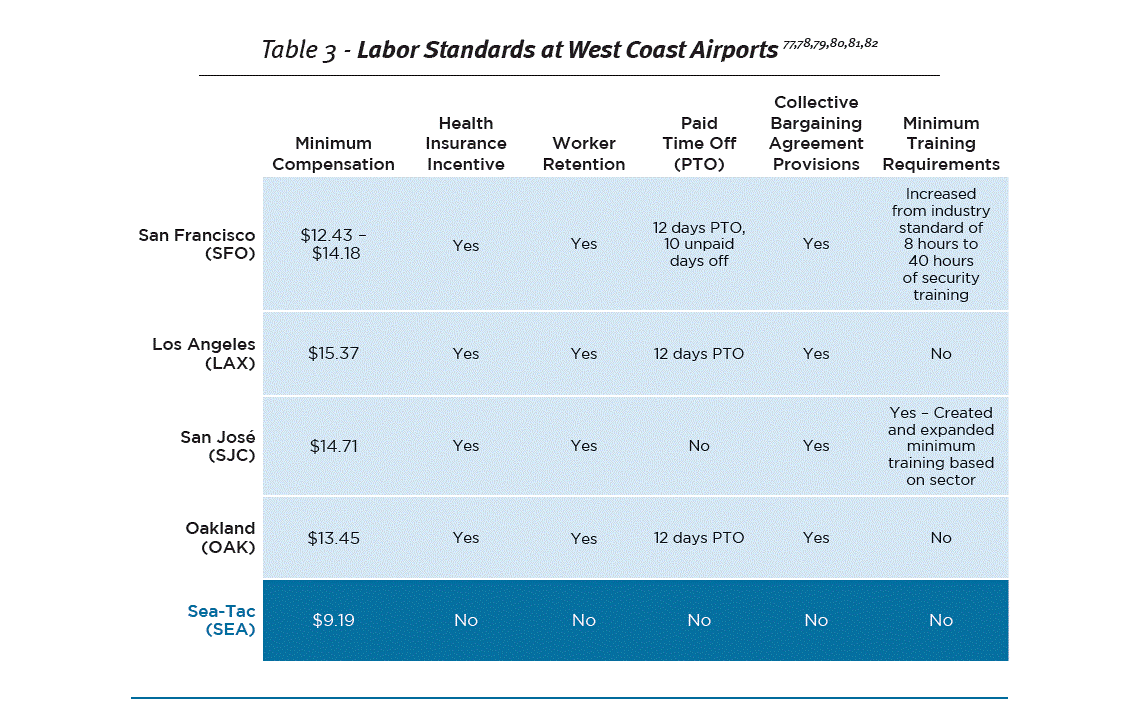
For example, the city of Los Angeles several years ago became concerned about sick leave policies that could contribute to germ “superspreading” at its airport and the public cost of airport workers with no health insurance. So in 2009, it extended its living wage ordinance to airport workers that requires:
- 12 paid days off and 10 unpaid days off annually
- A minimum wage of $15.37, with a credit of $4.67 towards the total if the employer provides health benefits
- Worker retention in the event the airport or airlines replace one contracting firm with another for the same function
Similarly, the city of San Francisco more than a decade ago passed standards that established a minimum living wage for airport ground service workers, access to health insurance and training designed to attract and retain a quality workforce. An analysis three years later showed that employee turnover fell by 60%, employees reported working harder and faster, and employers saw a decrease in grievances and absenteeism.
In Oakland, it was the voters themselves who overwhelmingly (by 78%) approved a ballot measure to create a living wage and other labor standards for airport and seaport businesses.
So, there appear to be multiple ways to take the lead on setting workforce standards for airport employees. And workers like Diallo are optimistic that conditions there can improve, if people want them to. As he puts it:
I love working at the airport. There are so many interesting people. It’s international, and you never know who you might meet there. But I feel like we’re not being respected at the job that we do. If we take the time and actually try to stand up to these guys and tell them how we feel and what is needed to be done in order to make every airport job a good job, I think we can make that happen.
Update: Sightline contacted the Port of Seattle, which owns Sea-Tac, and Alaska Airlines, the airport’s dominent carrier, for responses to Puget Sound Sage’s report. The port declined to comment at this time. Alaska Airlines spokeswoman Bobbie Egan provided this statement late in the day and emphasized that the company employs nearly 13,000 people who earn almost $1 billion a year in wages and benefits, with nearly half of those people working in the Seattle area:
Alaska Airlines partners with vendors that focus on safety and provide quality services at competitive pricing for entry-level jobs. Our focus is to offer our customers safe, reliable and affordable air travel while continuing to grow our business and create more jobs within Alaska Airlines and at our partner vendors. Although we do not dictate the wages our contractors pay their employees, we do understand the importance of having a strong local economy that provides plentiful, good-paying jobs. The most effective way Alaska Airlines can contribute to this goal is to make decisions that ensure our company thrives and continues to provide careers and financial security for thousands of employees and their families.


 Washington Work and Family Coalition