Weighing the Costs and Benefits of Enhanced Paid Sick Days in DC

Claudia Williams is a Research Analyst at the Institute for Women’s Policy Research, specializing in paid sick days and the status of women in the states. IWPR is a partner organization of the Washington Work and Family coalition.

On September 17, DC city councilmembers introduced the “Earned Sick and Safe Leave Amendment Act of 2013,” a proposal that would take the current DC paid sick days (PSD) law a step further in providing safeguards to workers in the District. While DC was among the first to pass citywide PSD legislation in 2008, the current law excludes a number of workers, and requires coverage only after workers have been employed by a particular employer for more than one year and 1,000 hours. The proposed amendment to DC’s existing policy, would not only expand protections to even more workers–including most tipped restaurant workers–in the District of Columbia, but also enhance enforcement and outreach efforts to reduce non-compliance reported in June 2013 by the Office of the District of Columbia Auditor.

This week, I testified before the DC City Council and shared findings from IWPR’s analysis of the probable impact of this amendment to DC employers. Using the parameters of the proposed legislation and publicly available data, IWPR researchers estimated some of the anticipated costs and benefits to employees and employers that might result from providing earned sick days to newly covered workers. Our analysis shows that if the amendment is enacted:

Employers of newly covered workers can expect to spend $5.60 per worker per week in providing new earned sick days in the District of Columbia (or $5.9 million per year for all newly covered workers). At the same time, providing new earned sick days is expected to yield benefits of $7.9 million—or $7.45 per worker per week—resulting in a net savings for Washington D.C.’s employers of approximately $2 million annually.

While there are certainly costs associated with implementing a new paid sick days policy, IWPR analysis shows that employers can expect see the cost of implementing this new policy more than offset by increased employee productivity, reduced costs associated with less contagion of communicable diseases, and reduced employee turnover.

Apart from these not-insignificant cost savings, there are other benefits to paid sick days that are more difficult to quantify but no less significant. In DC, these benefits are likely to include: improved health and more efficient utilization of health care; improved public health through reduced spread of contagious disease; and reduced expenditures on public assistance programs due to improved family economic security. There is a growing acknowledgement that many workers have financial responsibilities and caregiving responsibilities, a burden that often falls heavily on women workers, and could be eased with better access to paid sick days.

During the hearing at the DC council, many experts–and also workers–presented their testimony on the importance of minimum wage and paid sick days. Experts highlighted that, as we continue recovering from the recession, employee benefits are more crucial than ever. Worker after worker shared their experiences of having to choose between taking care of their and their families’ health, or making ends meet at the end of the month. Waiters and waitresses shared how instead of calling in sick, they showed up to the restaurant with contagious illnesses like the flu or norovirus because they couldn’t afford to take the day off.  Given the research, and the economic realities of many Washingtonians, who benefits from not providing paid sick days to workers?

Via the Institute for Women’s Policy Research.

Pregnant Women Need a Break

Carol Joyner is the Director of the Labor Project for Working Families (LPWF), in partnership with Family Values @ Work, a partner organization of Washington Work and Family Coalition.

Any woman who’s gone through pregnancy hears the same advice: hydrate more and listen to the needs of your changing body.

Almost everything a pregnant woman does requires adjustment. Eliminating caffeine and alcohol, hydrating more frequently, avoiding strenuous activities — all are immediate considerations, activities women have control over. But what happens when pregnant workers have little to no control?

For women throughout the U.S., doing what’s right when you’re pregnant can bring unnecessary hardship. All too often, pregnant women are forced to choose between what’s best for them medically and what they need financially. Too many employers deny requests for simple workplace accommodations — a chair, an extra bathroom break, a bottle of water to drink — and fire pregnant women, forcing them to go on unpaid leave or quit their jobs at a time when they most need financial security.

The National Women’s Law Center and A Better Balance recently published a report shedding light on the difficulties that so many pregnant women face on the job. The stories they’ve collected detail a variety of abuses. Denial of fluids, being forced to stand, being refused bathroom breaks — all are common complaints about employers who, in denying these rights, often break the law.

During her pregnancy, Hilda Guzzman, a full-time Dollar Tree employee in Long Island, asked her boss for a stool to sit on while working at the register for 8-10 hours a day. The response? “You can’t get special treatment,” her boss declared, “since a man can’t get pregnant.” The pressure from standing all day caused bleeding and premature labor pains, landing Hilda in the emergency room every few days. Quitting was not an option: Guzzman needed the job to be able to cover her medical expenses and pay the rent.

Dr. Lucy William, an emergency room doctor, treated a pregnant cashier who arrived at a New York hospital with severe dehydration. Turns out her employer refused to let the cashier drink water at the register.

In most states, pregnant women lack basic job protections for pregnancy-related accommodations. The federal Pregnancy Discrimination Act (PDA) offers protection against discrimination — being treated differently from non-pregnant co-workers. But the law does not include safeguards should a woman need work adjustments as a result of her pregnancy, such as rest breaks, assistance with manual labor and recovery time following childbirth. As KJ Dell’Antonia writes in The New York Times, “Sometimes equal treatment is not enough to allow a woman to stay on the job.”

Fortunately, a growing movement of activists, organizations and elected officials are championing workplace fairness for pregnant women. Just recently, New York City took a major step in ensuring that pregnant women are not forced to choose between their health and their job. In a unanimous vote, the City Council passed the Pregnant Workers Fairness Act (PWFA), which stipulates that employers in New York cannot force pregnant workers out of their jobs or deny them reasonable job modifications. The city joined a handful of states, including California, Illinois, Hawaii, Louisiana, Maryland and Texas, that have offered similar safeguards to pregnant women.

2013-10-29-PregnantWomen.jpg
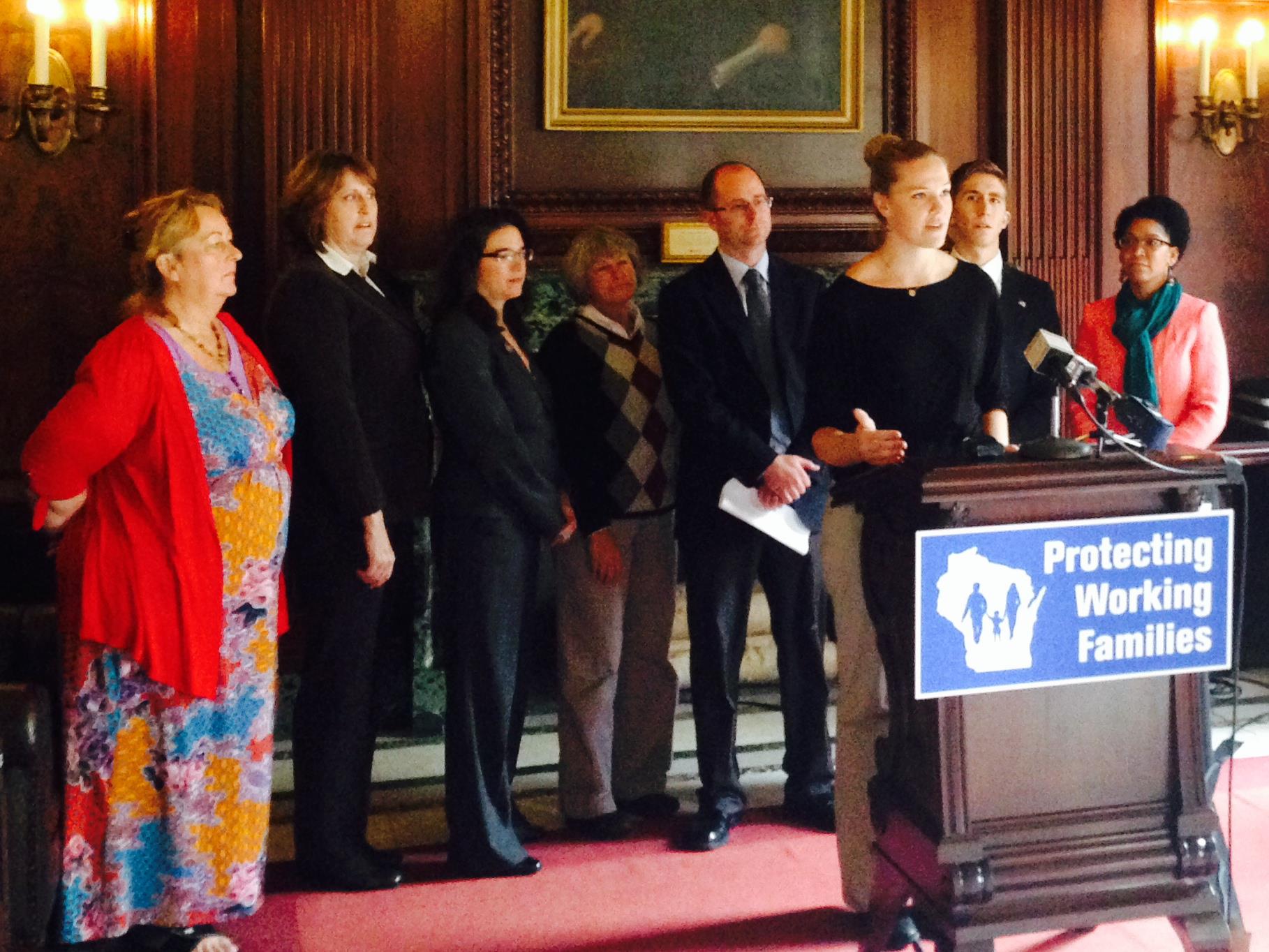
Members of 9to5 Wisconsin, an organization dedicated to winning justice for working women, join with Wisconsin legislators to push for pregnancy fairness.

In Washington, legislators are also taking note. The federal Pregnant Worker’s Fairness Act (PWFA), re-introduced earlier this year in both the House, by Jerrold Nadler (D-NY), and the Senate, by Robert Casey (D-PA), would close existing loopholes, ensuring that workers have reasonable accommodation for pregnancy, childbirth and related medical conditions. In recognition of the 35th Anniversary of the PDA on October 31, groups from across the country are planning a week of advocacy to highlight the important milestone the PDA represents and to push for greater protections for pregnant women on the job.

As the economy changes, so too should our workplace protections. Three-quarters of women now entering the workforce will become pregnant while working. Many, particularly low-wage women working in retail and service jobs, know all too well the dangers associated with lacking basic work accommodations.

Legislative protection like the PWFA leaves us all healthier — women and families, employers and taxpayers alike. It improves the health of women and children, decreasing the likelihood of childbirth-related complications. It guarantees economic security for millions of pregnant women and their families. It strengthens our economy by protecting jobs. And it benefits small businesses’ bottom line through reduced turnover, increased employer loyalty and higher productivity.

Pregnant women in our country deserve better; their work has value and their children make up our future society. Think about your mom, your sister or daughter. If you agree that they deserve basic guarantees and opportunities, then join with millions of Americans who support the PWFA. It’s beyond time that pregnant women get a break.

Via the Huffington Post

The silver tsunami is coming – Family and Medical Leave Insurance can help us prepare

Gov. Jay Inslee
Gov. Jay Inslee speaks at the 2013 Summit on Aging. Photo via @GovInslee

Cross-posted from the Economic Opportunity Institute:

Last week, Governor Inslee hosted the first-ever Leadership Summit on Aging. Initiated by AARP Washington, the goals of the summit are to address the upcoming “silver tsunami”- when many baby boomers are set to retire. However, hopes are to address concerns beyond just retirement, and have the conversation expanded to all aspects of ageing.

“We want to perfect ideas on how we can improve access to living situations. We want to help make sure people are getting good health care. We want to deal with these financial planning issues – and we’re looking for ideas on how to help,” Inslee said.

Joined by policymakers, experts and opinion leaders on aging, their one-day summit focused on these three framing points:

  • Focus on the age wave on the horizon.
  • Identify key risks and opportunities for Washington State.
  • Explore strategic actions the state can take to reduce pressure on future state budgets and create a more age friendly environment.

Ideas discussed during the summit will be followed up with the new Joint Legislative-Executive Committee on Ageing and Disability for the 2013-2015 biennium. Comprised of representatives from the House, Senate, and executive branch including the Secretary of DSHS, Director of the Health Care Authority and Director of Department of Retirement Systems, the goals of the new committee are outlined as:

  1. Establishing a profile of Washington’s older population and population with disabilities and a projection of those populations through 2030;
  2. Establishing an inventory of services and supports from health care and long-term services and supports;
  3. Identifying budget and policy options to effectively use public resources to reduce the growth rate in state expenditures compared to current policies;
  4. Identifying strategies to better serve the health care needs of the aging population and people with disabilities and promote healthy living;
  5. Identifying options for financing mechanisms for long-term care services and supports to promote additional private responsibility to meet needs for services.
  6. Identifying options to promote financial security in retirement, support people staying in the workforce, and expand the availability of workplace retirement savings plans; and
  7. Identifying options to help communities adapt to the aging demographic in planning for housing, land use, and transportation.

Here at EOI, we have our own recommendation. Start with implementing, expanding and funding Washington’s Family and Medical Leave Insurance (FMLI) passed in 2007 but has had implantation delayed twice until 2015.  Currently, the FMLI program provides up to 5 weeks of partial pay to employees who need to take care of an aging parent or newborn.

To truly be a family friendly policy, FMLI needs to be expanded up to 12 weeks with 2/3 of weekly pay, up to $1,000 a week. Employees need the flexibility to respond to the myriad of medical and care-giving needs that aging populations face – without worrying about the stability of their job or paycheck.

Let’s keep pushing as we head into the upcoming legislative session for policies that reflect the full spectrum of today’s modern family needs. Washington state needs workplace policies that support all of our loved ones, no matter their age.