New Jersey city passes paid sick leave, continuing the state’s unstoppable momentum

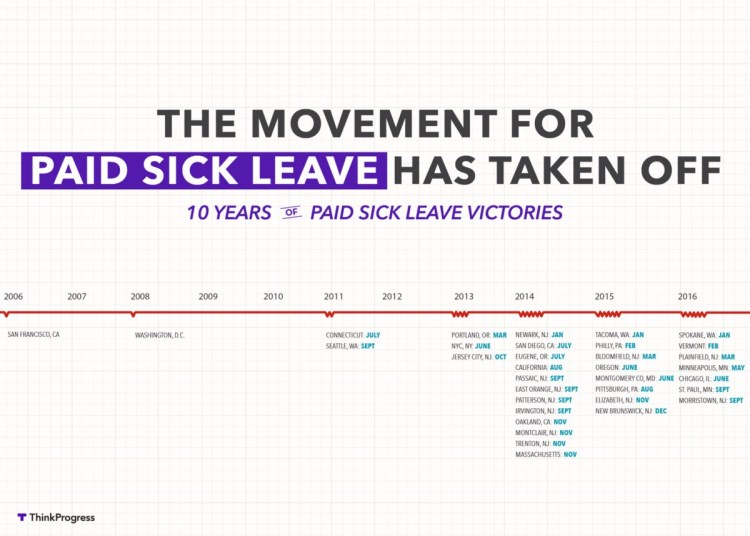
This week, a town in New Jersey passed a law requiring businesses to offer all employees paid sick leave, becoming the 13th place in the state to do so and the 34th in the country.

Morristown workers at companies with 10 or more employees will be able to take up to five days a year, while those with fewer will get three days. All employees, both full time and part time, will be eligible. An exception was made for those who work in food service, childcare, and eldercare positions, who will get five days no matter how big their employers are to protect public health.

With its passage, there are now 29 cities and five states across the country that require businesses to offer employees a paid day off if they or their families get sick, even as there is no national requirement to do so.10-years-of-psd-victories
Activists in New Jersey had originally planned to have Morristown residents vote on paid sick leave through their November ballot, but the city council decided to take action ahead of time on its own.

New Jersey has become a powerhouse of paid sick leave laws, passing seven in 2014 alone. Those behind the movement are hoping to get even more in place before the end of the year.

“Our aim is to move 1–2 more towns this year, and ultimately bring NJ to 15 municipal ordinances before the close of the year,” Analilia Mejia, executive director of New Jersey Working Families, said in an email.

The state’s paid sick days movement was launched shortly after it passed the country’s second paid family leave program. (There are now four states that have paid family leave.) Then New York City, the country’s largest, managed to pass paid sick days in 2013, and activists in New Jersey decided to focus on going city by city, especially since Gov. Chris Christie (R) has stood staunchly in opposition to all sick leave legislation, including something statewide.

But dozens of laws across the country, most of them over the last three years, have now been put into effect. They campaigns have even moved beyond coastal cities to stake claims in the midwest. They’re already having an impact: the share of Americans who get paid sick leave from their employersjust reached an all-time high, climbing 7 percentage points over the last decade in which sick leave laws started to take root.

And while Congress still hasn’t acted on bills that have been introduced to require all American companies to offer paid sick leave, these cities and states have proven that doing so doesn’t harm businesses or jobs. Employers inConnecticut, Jersey City, New York City, and Washington, D.C. say the laws haven’t been costly or difficult to implement. Job growth remained strong inConnecticut and San Francisco after the laws were passed, and was actually stronger in Seattle.

[Original: Bryce Covert at ThinkProgress]

Study: ‘B-minus’ for WA workplace laws concerning expectant and new parents

Photo credit: Diana Nguyen/Flickr Creative Commons

SEATTLE — The Evergreen State has room for improvement when it comes to protecting working families, according to a new report. The National Partnership for Women and Families gave Washington a “B-minus” grade in a recent study assessing states’ workplace policies to protect expectant and new parents – including paid family leave and workplace accommodations for pregnant women.

According to Marilyn Watkins, policy director at the Economic Opportunity Institute and head of the Washington Work and Family Coalition, there’s one bright spot for Washington parents who need time off to care for their children.

“Over a decade ago now,” Watkins said, “Washington passed a law that says that if you do have paid leave – paid sick leave or some other kind of paid time off – you can use that leave not only if you’re sick yourself, but also if you have a sick child, spouse, parent, parent-in-law, grandparent.”

Only California received an ‘A’ grade in the report. Both New Jersey and the District of Columbia received an ‘A-minus.’

A pregnant woman in Washington can also take as much time off as necessary without having to worry about losing her job, Watkins said. But she won’t necessarily be paid for that time.

Sarah Fleisch Fink, director of policy and senior counsel with the National Partnership for Women and Families, said that while Washington has taken steps in the right direction, workers in low-wage jobs are disproportionately affected by inadequate workplace protections.

“For workers in low-wage jobs, they are even less likely to have access to paid leave, they are even less likely to have access to paid sick days and to other protections,” she said. “And in many cases, they are even more in need.”

A state ballot initiative this year could help alleviate some of the financial stress for expectant and new parents, Watkins said. Initiative 1433 would raise the minimum wage statewide to $13.50 an hour by 2020, and also provide workers with paid sick leave. According to Watkins, more than a million workers in Washington currently don’t have a single day of paid sick leave.

“So, they are going to hugely benefit from having access to paid sick leave for the first time; so will their kids, so will the elders in their family,” Watkins said. “We’re all going to be healthier when workers aren’t forced to make the choice between going to work sick or putting groceries on the family’s table that week.”

Via Public News Service »

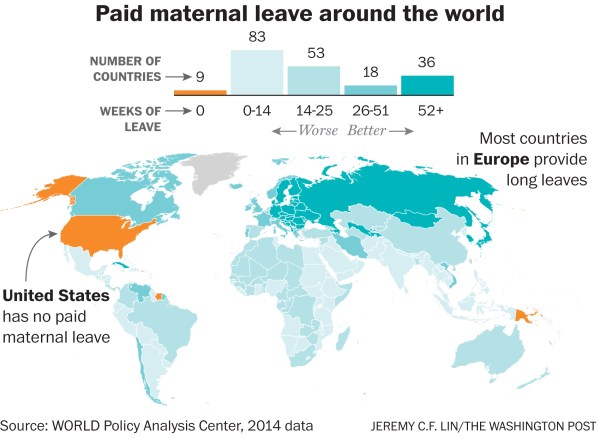
The world is getting better at paid maternity leave. The U.S. is not.

matleave-map

When news broke that Ivanka Trump’s clothing line doesn’t offer workers paid maternity leave, some were surprised. After all, the Republican presidential nominee’s daughter has said she champions the rights of working mothers. “Policies that allow women with children to thrive should not be novelties,” she said on the last day of the Republican National Convention in July. “They should be the norm.”

The truth is, however, that in the United States bearing a child comes at a high price for many women. Despite having one of the world’s most advanced economies, the United States lags far behind other countries in its policies for expectant mothers. In addition to being the only highly competitive country where mothers are not guaranteed paid leave, it sits in stark contrast to countries such as Cuba and Mongolia that offer expectant mothers one year or more of paid leave.

Countries finance paid-maternal-leave policies in a variety of ways. Some require that the employer finance the leave; in others, the money comes from public funds. For low-income residents or those who work in the informal sector, an increasing number of governments are providing maternity cash benefits, according to the International Labor Organization, a U.N.-affiliated agency.

The graphic above highlights just how poorly the U.S. compares with the rest of the world. It shows that this is the only advanced economy that does not mandate paid leave for mothers at the federal level.

Full story: Washington Post