Growing Attention on Paid Leave as a Dimension of Inequality

MomsRising
Via MomsRising

President Obama, in his most recent State of the Union address,  predicted that fighting inequality would be the “defining project of our generation.” The President’s forecast reflects a growing concern among most Americans about rising economic inequality. Conversations about inequality often focus on the wage gap between those at the top and those at the bottom. However, increasingly, advocates, policymakers, and members of the public have come to recognize that other aspects of compensation, such as paid family and medical leave and earned sick time, are an important part of the equation. The relationships between inequality and these policies, along with others that enable workers to do their jobs and care for their families, are the focus of several new reports.

The Office of the Assistant Secretary for Planning and Evaluation at the U.S. Department of Health and Human Services recently released, Work-Family Supports for Low-Income Families: Key Research Findings and Policy Trends, which provides an overview of research on the effects of paid family leave, paid sick leave, and workplace flexibility on the well-being of low-income working parents and their families. The paper notes the positive impact such policies have on child development, parents’ financial stability, employers’ productivity, and the public health. Pamela Winston, the author of the report, explains, “[A]ccess [to these policies] is highly skewed by wage levels and other job characteristics in ways that mean the lowest income families tend to have the least access to all types of work-family benefits.” Given the host of benefits associated with access to leave and flexibility, the paper underlines how unequal access further exacerbates existing inequalities.

A recent examination of data from the National Health Interview Study (NHIS) by the Institute for Women’s Policy Research (IWPR) also highlights the ongoing stratification of access to paid sick days. IWPR’s brief shows that fewer than three in ten workers making $19,999 a year or less have access to any paid sick days. In contrast, among those making $65,000 or more annually, eight in ten workers have access to paid sick days. Access to paid sick days also varies by race. Only 47 percent of Latino workers have access to paid sick days, compared with 64 percent of white workers and 62 percent of black workers.

CLASP’s recently published brief, Access to Paid Leave: An Overlooked Aspect of Economic & Social Inequality, highlights other ways that lack of earned sick days and paid family and medical leave can entrench inequality, including the potential for job and wage loss among workers who lack protections but must take time away from work to care for themselves or their families. The brief also points to a recent survey showing that nearly half of low-wage workers (those in the lowest 25 percent of the wage scale) lack any form of paid leave: no vacation, no personal days, no sick days, and no family leave.

Media outlets have also been paying attention to this aspect of economic inequality. In a recent New York Times piece, Judith Warner argued that public policies to support working families are an obvious and simple part of the solution to growing inequality. Warner got at the crux of why unequal access to paid leave needs to be addressed as an urgent economic issue: “What this all means is that the people who are already in the most precarious economic circumstances are the most at risk for devastating loss of income – and assets – when they need to care for their children.” This is also true for workers who become ill themselves or need to care for other sick family members, such as parents or siblings.

With Thomas Pikkety’s book on inequality flying off the shelves, it is clear that Americans are eager to find solutions to the many problems that contribute to the current injustices in our economy. Paid leave and other policies to support workers with caregiving responsibilities are a critical but often overlooked part of the solution.

Via CLASP
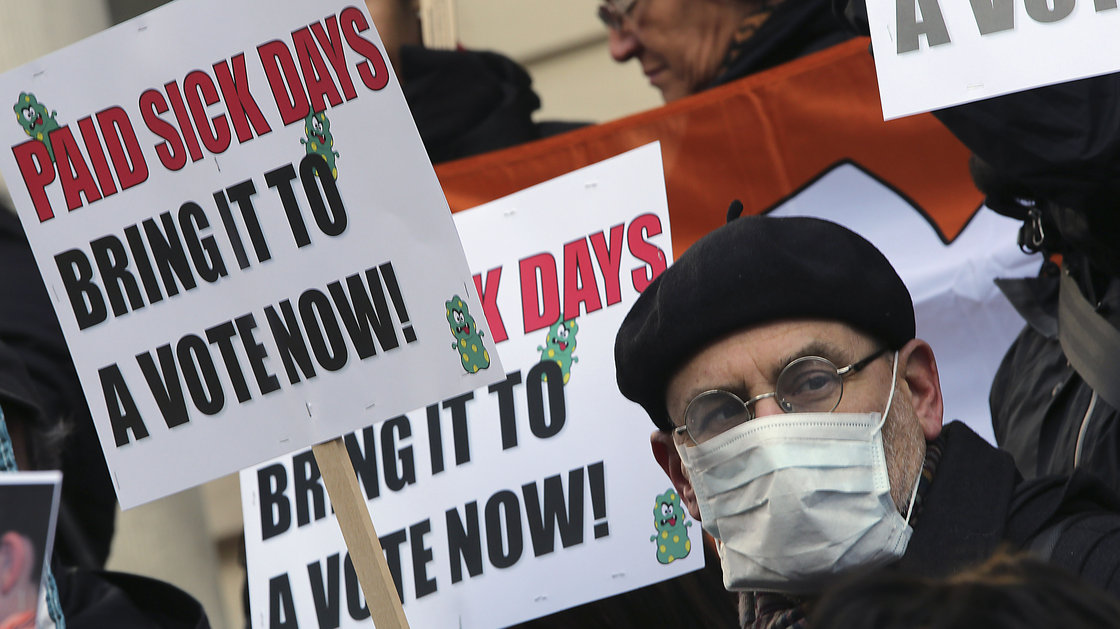
Advocates Back Paid Sick Leave, But Opponents Won’t Cough It Up

Last month, New York City began requiring employers to provide paid sick days, joining the ranks of other cities such as Washington, Seattle and San Francisco. Photo: Mary Altaffer/AP

If you’ve ever seen your waiter sneeze, you may have asked for a different server. If you’ve seen one sneeze repeatedly, you might wonder why he’s still at work, serving tainted food.

See, most restaurant workers don’t get paid when they stay home sick. But, some go to work anyway, when they’ve got the sniffles or worse, because they need the paycheck.

For labor advocates, that’s a problem.

“The fact that we’re forcing people to go to work sick is not something we want to do as a society,” says Maryland state Rep. John Olszewski Jr., a Democrat. “We shouldn’t put people in a situation where they’re forced to make impossible choices between themselves and their work and their families.”

Last month, New York City began requiring employers to provide paid sick days, joining the ranks of other cities such as Washington, Seattle and San Francisco.

But while several cities have been willing to impose such requirements, states have been more reluctant. Olzewski’s bill attracted a majority of his fellow state House members as co-sponsors, but went nowhere this year.

Instead, a number of states — particularly in the South — have passed laws that block local governments from imposing sick day requirements on businesses.

Get the full story from NPR »

The day after Mother’s Day: An overdue economic gift for moms

mom-and-workMost kids today grow up with their mom in the workforce. According to the U.S. Census Bureau, two-thirds of new mothers now return to paid work within a year after giving birth, usually in the first few months.

Back in the 1960s, fewer than one in five new mothers held a paying job. In those days, while the middle class was expanding rapidly, the majority of families had one breadwinner and one fulltime homemaker. Unfortunately, we still organize our economy as if “women’s work” had little economic value and every family had a fulltime caregiver.

Women have gained tremendous new opportunities in the 50 years since Congress banned employment discrimination on the basis of race and sex. Jobs and activities once reserved exclusively for men are open. So are educational pathways. Women now make up a majority of college graduates and roughly half the workforce. Instead of earning only 60 cents to a man’s dollar, women working fulltime now earn 77 cents.

But most of that progress was made last century. Since 2000, women’s career and earnings gains have largely stalled.

Men and women still tend to pursue different careers. Here in King County, men hold eight in ten computer and math-related jobs and three-fourths of police and fire department jobs. Women make up two-thirds of health technicians and office administrators and 90% of childcare workers. The typical woman in King County makes $15,000 less each year than the typical man.

Still, up to 40% of the wage gap cannot be explained by differences in jobs, hours worked, education or experience. Too often women get paid less than men in the same job simply because employers can get away with it.

On top of that, the United States, unlike every other advanced economy, leaves working families on their own to cope with care giving. Without uniform standards in place, four in ten workers get no paid sick leave and only half of working women get paid maternity leave – usually cobbled together from saved up sick leave and vacation.

Those with the highest pay are most likely to get paid leave benefits. They are also best able to afford the high cost of quality childcare, which can exceed college tuition – even though childcare teachers earn near-poverty wages.

Because women get paid less and have limited access to paid leave, families suffer bouts of economic insecurity. Staying home with the flu, or caring for a sick child or ailing parent too often means loss of needed income. Women go back to work before they’ve fully recovered from childbirth or established breastfeeding. They accumulate less for retirement and can’t save for their children’s education.

If women received fair pay and had access to paid sick days and to paid family and medical leave, kids would be healthier and better prepared for success in school and life. Fewer seniors would live in poverty. Local businesses would have more customers. Our communities and our democracy would be stronger.

Here’s my Mother’s Day wish list for Washington’s women:

  • Fair pay. Discussing compensation with coworkers should not be a fire-able offense. Employers should have to justify pay differences on some basis other than sex or race.
  • Paid Sick Days. We know that Seattle’s sick leave law has extended paid leave to tens of thousands, while the city’s economy has grown faster than the rest of the state. According to the latest UW study, 70% of Seattle business owners support the law. It’s time to take it statewide.
  • Family and Medical Leave Insurance. Five states already have programs. Women in these states take longer maternity leaves, suffer fewer health complications, are more likely to breastfeed and take their babies to medical checkups. They are less likely to go on public assistance and more likely to be working and earning higher wages a year after giving birth. Let’s pass Washington’s FAMLI Act in 2015.
  • We won’t get these done by Mother’s Day – but if everyone passes this list on to their state legislators and candidates, we can give them to our moms and ourselves for next Valentine’s Day.

Originally published in the South Seattle Emerald.