Local Leaders in the Fight for Paid Sick Days, Family Leave and Equal Pay Bring Campaign to the other Washington
 Washington workers, business owners and elected leaders will bring experiences from their fight for paid leave and equal pay laws to the first-ever White House Summit on Working Families in Washington, D.C. on Monday.
Washington’s White House Summit delegation includes working families champion Representative Laurie Jinkins, retail worker and Tacoma sick days advocate Amanda DeShazo, restaurant owner Makini Howell and Washington Work and Family Coalition leader Marilyn Watkins.
At the pre-summit forum at Tacoma Community College Wednesday evening, local women shared stories about the challenges facing working women and families. Wendy Banks, a meat cutter at a local grocery store, shared how she had to repeatedly lobby management in order to be trained in the profession traditionally dominated by men. “My dad was a meat cutter. I worked in the meat department for years, but every time I applied for training as a cutter, there was some excuse why I was denied. Then I found out that men without any grocery experience were being hired straight into the role. I filed a grievance, and finally got a shot at the higher paying job.”
Di Inman, co-owner of Positive Approach Dog Training and Daycare, described growing up with a breadwinner mother who could not take a day off when her kids were sick. “We’ve offered paid sick leave and fair wages from the time we bought our business,” said Inman. “Because we prioritize our employees, morale is high and our business has grown. No one has abused our policies. When you treat people wonderfully, they become wonderful people!”
State Representative Tami Green and Senator Jeannie Darneille also shared personal experiences that have convinced them that adopting legislation for paid sick days and family and medical leave insurance is critical for women and families. “Our state’s prosperity depends on women’s economic security and success,” said Green.
Nearly 1 million workers in Washington don’t have access to a single paid sick day, and only 12 percent of the U.S. workforce has access to paid family leave to welcome a new child or care for an ailing parent. Washington women earn just 78 cents on every dollar – amounting to $10 billion in lost annual income due to the pay gap. Policies like paid sick days, family and medical leave insurance and equal pay laws build economic security for working women and families.
“A 21st century workforce needs a 21st century workplace – the White House Summit will bring together local and national leaders ready to make that happen,” stated Marilyn Watkins, policy director of the Economic Opportunity Institute and leader of the Washington Work and Family Coalition. “Women make up half of the U.S. workforce, but our workplaces haven’t caught up with that reality. Paid leave – whether to welcome a new baby or care for a sick child – and equal pay protections are key policy reforms that will help women and families thrive.”
At the Summit, President Obama will join activists, workers, caregivers and other elected officials from the Family Values @ Work network and elsewhere to focus on creating a workplace that works for all. The president has made the women’s economic agenda a critical component of his efforts to rebuild the economy. In his 2014 State of the Union, he called for an end to ‘Mad Men’-era policies, and in a recent appearance in Orlando he urged Congress to bring the United States in line with “every other advanced nation on Earth by offering paid leave to folks who work hard every day.”
President Obama’s leadership reflects growing national momentum and grassroots advocacy for policies that value families. Last year, three cities – New York City, Portland and Jersey City – passed paid sick days laws, joining San Francisco, Seattle, D.C. and the state of Connecticut. So far this year, Newark passed a similar ordinance and New York City expanded its sick leave law. Citywide laws or ballot initiatives are currently under consideration in Chicago, Eugene, Ore , Tacoma, San Diego, Oakland and several places in New Jersey; and statewide initiatives are gaining steam in California, Massachusetts, and elsewhere. Also in 2013, Rhode Island joined California and New Jersey in passing paid family leave, with Washington, New York, Colorado and other states considering similar legislation.
“Together, we can make our families healthier and stronger,” stated Rep. Laurie Jinkins who sponsored the statewide paid sick leave bill this year. “At the White House, I’ll be sharing stories from business leaders who tell me that high-road employment practices – like sick leave or fair pay – are common sense, effective and smart ways to both do right by their employees and ensure their company’s long-term success.”
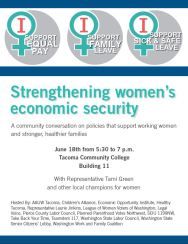 A community conversation on policies that support working women and stronger, healthier families with Representative Tami Green and local champions for women.

 Washington Work and Family Coalition