
On Your Mark, Give Birth, Go Back To Work

Tricia Olson takes a selfie of herself and her son Augustus, or Gus, who sits in his car seat. Olson took three weeks of unpaid leave from her job at a towing company in Rock Springs, Wyo., after giving birth. Courtesy of Tricia Olson
Tricia Olson takes a selfie of herself and her son Augustus, or Gus, who sits in his car seat. Olson took three weeks of unpaid leave from her job at a towing company in Rock Springs, Wyo., after giving birth. (Courtesy of Tricia Olson)

On her first day back at work after giving birth, Tricia Olson drank copious amounts of coffee, stuffed tissues in her pocket, and tried not to cry. After all, her son Gus was just 3 weeks old.

Olson, 32, works for a small towing company and U-Haul franchise in Rock Springs, Wyo., and she could not afford to be away from work any longer.

“The house bill’s not going to pay itself,” she says, her voice breaking in an audio diary she kept as part of a series on the challenges facing working parents airing on NPR’sAll Things Considered.

Olson is one of just four employees she says are “like family,” and like many U.S. workers, she has no paid leave at all: not for vacation, not if she gets sick, and certainly not for parental leave.

Normally, she’s the only one in the office to take calls. Her boss agreed to fill in for her for three weeks after the delivery, but she says “even just that … makes me feel guilty.”

Olson is hardly alone in returning to work so early. But this is a uniquely American problem.

Ed. Note: It doesn’t have to be this way! The Washington Work and Family Coalition is working with champions in the legislature to craft a paid family and medical proposal for our state that we hope to pass in 2017. Join the cause here: http://bit.ly/2cQCLrz

Read more: NPR.org »
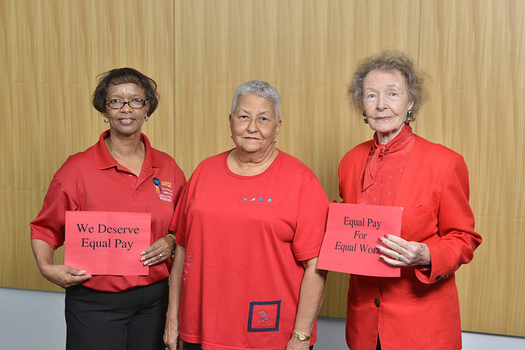
Report: At Current Rate, Women Won’t Close Pay Gap Until 2059

Full-time working women in Washington make about 79 percent as much as their male counterparts. (AFGE/flickr)

If the gender pay gap continues to close at its current rate, women will reach pay equity with men in 2059, according to a new report from the American Association of University Women. Called The Simple Truth about the Gender Pay Gap, the report finds full-time working women are slowly closing the disparity, making about 80 percent nationally of what their male counterparts make.

Marilyn Watkins, policy director at the Economic Opportunity Institute, said the issue isn’t just that women are paid less for the same job title. Often, as in the technology field, they are shuffled into lower-paying positions.

“Men might get the job as coders, which are the most highly paid jobs, and women get slotted into the testing part, where they still have to have a lot of computer and technology skills but they just get paid less and they don’t have the opportunity to really rise up in the organization either,” she said.

In Washington, full-time working women make 79 percent of what men working full-time make, according to the report.

Watkins said Washington state could strengthen its equal-pay laws by looking to other states. This summer, she said, Massachusetts passed one of the strongest equal-pay laws in the country, which makes sure companies pay equally for comparable jobs and job requirements.

“For example, cafeteria workers and custodians might be deemed comparable jobs even though one is traditionally female and gets paid a lot less than the traditionally male custodial jobs,” she added.

Equal-pay legislation, such as bills that provide for wage transparency, have failed in Washington’s Legislature over the past few years. But Watkins said the paid sick-leave initiative on this year’s ballot could boost Washington women in the workplace.

The report also found that African-American women make about two-thirds and Hispanic or Latina women make about half of what white men make nationwide. Watkins said it’s important to think about how policies that close the gender pay gap affect women of color as well.

“We really do need to include a racial equity lens as well as a gender equity lens when we’re looking at policies,” explained Watkins. “All of these policies will really help end some of the racial inequities as well as some of the gender inequities.”

The full report can be read here.

[Via Public News Service]

Of course Hillary Clinton went to work sick. That’s the American way.

hillary-clintonAs Democratic presidential nominee Hillary Clinton demonstrated when she nearly collapsed from the effects of walking pneumonia early this week, the benefits of running for elected office may include many things, but sick days are not among them.

This is perhaps unavoidable in light of the fact that the job of actually being an elected official doesn’t allow for much rest and recuperation, either — see, for instance, John F. Kennedy plowing ahead despitecrippling back pain and Addison’s disease, which he wanted to conceal from the public; and George H.W. Bush ignoring a doctor’s advice in 1992 to stay in bed rather than attend a state dinner in Japan, with the result being that he vomited on the Japanese prime minister. “The president is human,” Bush’s physician told reporters at the time. “He gets sick.”