You helped pack the room on Monday for the Paid Sick Days (HB 1356) bill hearing. Legislators heard passionate testimony from a school nurse, a grocery worker, a small business owner, a domestic violence advocate and a senior — all speaking to the importance of every worker having paid sick days.
And just this morning (Jan. 29), the House Labor Committee voted to pass the bill out of committee!
Here’s the next crucial step: the House Appropriations Committee will consider whether to send the bill to the full House for a vote. Please click here to send an email urging committee members to support Washington workers by moving paid sick days to the full House for a vote!
Your action today will help ensure over 1 million workers in Washington state can earn paid leave to care for themselves or a loved one – including 170,000 people working in accommodation and food service, 167,000 in retail and 93,000 in health care and social assistance.
More great news!
Healthy Tacoma supporters turned out in force to show their support for a strong paid sick days ordinance to Tacoma’s City Council
There’s another important committee hearing coming up — if you’re in Olympia, please sign in support of the Equal Pay Opportunity Act (HB 1646), to be heard on Monday, February 2 at 1:30 pm.
And finally, a big congratulations to our sister coalition Healthy Tacoma! Thanks to their two years of hard work, on Monday Tacoma’s City Council passed a Paid Sick and Safe Leave ordinance that will cover all workers in the city starting February 2016!
Two bills to improve economic security for Washington’s working families are off to a strong start in the 2015 legislature:
1. Paid Sick Days, to ensure everyone working in Washington can earn paid sick days on the job (HB 1356/SB 5306)
2. Family and Medical Leave Insurance funding and expansion which will (finally!) make paid family leave available to Washington workers and their families (HB 1273).
The paid sick days bill has unprecedented support with 43 sponsors, and the family leave insurance bill has similarly strong support — but there’s one thing missing: you!
Both bills are both scheduled for hearings next week — can you come to Olympia to show strong citizen support for either one (or both) of these bills?:
Paid Sick Days: Monday, January 26, 1:30-3:30 p.m. – Hearing Room B, John L. O’Brien building, Olympia
Family Leave: Thursday, January 29, 8:00-10:00 a.m. – Hearing Room D, John L. O’Brien building, Olympia
If you’re not able to make it, we understand – but there’s still a way you can help: tell us about a time when you or a loved one really needed paid sick days or family leave insurance, but didn’t have it. Or a time when you had leave, and really relied on it to keep yourself or your family healthy.
Legislators are bombarded by facts and figures every day; it’s the personal stories that really resonate with them. Let’s make sure they won’t forget why paid sick days and family leave insurance matter so much to Washington families!
By Marilyn Watkins, Ph.D and Sam Hatzenbeler, MPHc, Economic Opportunity Institute
Click to download PDF of full brief
From high-profile CEOs and movie stars to healthcare and retail workers, men consistently make more than women. Social scientists and economists have found clear evidence that gender-based discrimination persists – and is so deeply ingrained in culture and practice that it often goes unrecognized. Ensuring that all employees have the right to discuss and ask about pay and job opportunities, and that anti-discrimination laws are effectively enforced, will benefit women, families, businesses, and our state economy.
More than seventy years after Washington State banned paying women less for similar work, women’s pay still trails significantly behind men’s. Women make up almost half of the workforce and are either the sole or primary breadwinners in over 40% of families with children nationally. Yet, the typical Washington woman who worked full-time, year-round in 2013 took home only 80 cents for every $1.00 made by a man.
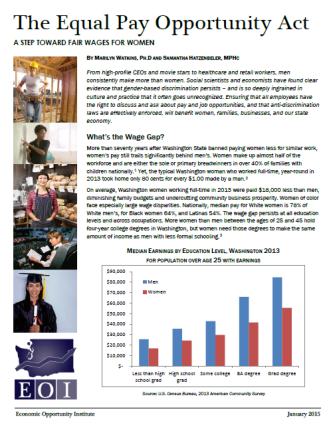
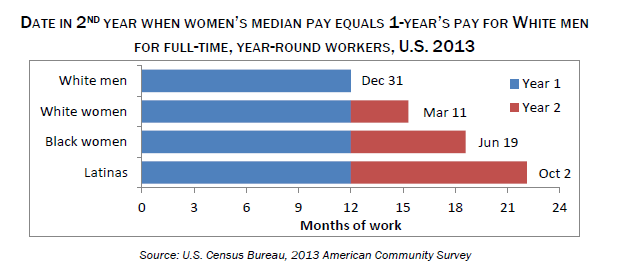
On average, Washington women working full-time in 2013 were paid $18,000 less than men, diminishing family budgets and undercutting community business prosperity. Women of color face especially large wage disparities. Nationally, median pay for White women is 78% of White men’s, for Black women 64%, and Latinas 54%. The wage gap persists at all education levels and across occupations.
Why is there a Wage Gap?
The wage gap persists for a few key reasons:
Occupational segregation and devaluing “women’s work”: Continued occupational segregation and the lower value society assigns to “women’s work” explain a big part of the wage gap. Segregation persists and men’s jobs pay more within occupational categories.
Time out for family care: Women are more likely than men to work part-time and to take time out of the workforce for family care responsibilities. In Washington, women make up 47% of the full workforce, but hold only 41% of full-time, year-round jobs.
Motherhood penalty: On average, mothers tend to make lower wages than women without children, regardless of education and hours worked.
Discrimination: Economists have found that up to 40% of the wage gap cannot be explained by differences in occupation, industry, union membership, education or experience. At least part of this “unexplained” wage gap is related to discrimination.
Why Existing Laws Aren’t Enough
Washington State passed an Equal Pay Act in 1943 during World War II, when many women were performing traditionally male jobs. That law prohibits paying women less than men in similar work or in jobs formerly held by men. But to pursue a discrimination claim under this law, a woman would have to sue her employer in court and could only recover lost wages, not court costs or attorney fees.
Both Washington State and the federal government have passed additional anti-discrimination laws that protect people in a number of categories, including gender, race, disability or veteran status. Under these laws, however, women must prove intentional discrimination.
Many women never find out they are being paid less due to pay secrecy. While salary information is usually openly available in public sector jobs, one third of private firms admit in national surveys to actively discouraging or prohibiting employees from discussing their pay with other employees.
Modernizing state law: The Washington Equal Pay Opportunity Act
No single policy will close the gender pay gap, but some simple policy changes will make it easier to identify and challenge practices that have discriminatory results:
Protect the rights of all workers to discuss or ask about compensation, and prohibit retaliation against employees who do so. This will enable workers to find out if others in the company are being paid more for the same work.
Protect the right of workers to ask why they are being paid less, or why they do not have the same access to job or career opportunities as others.
Authorize the Department of Labor and Industries (L&I) to investigate charges of gender discrimination so that workers aren’t forced to go to court, and require employers to justify differences with job-related reasons, such as education, skills, or experience.
Pushing to the Next Level
Greater transparency in the workplace will provide everyone with more opportunity to gain equal wages. It will also open new career opportunities for more women and begin to challenge society’s general undervaluing of women’s work. Stronger fair pay legislation, together with more family-friendly workplace policies such as paid sick days, family and medical leave insurance, and reasonable accommodations for pregnant and breastfeeding women, will boost family budgets and women’s lifetime incomes. Local businesses will benefit, and our economy and communities will be stronger, when women have the opportunity to achieve equal pay.



 Washington Work and Family Coalition