Millennial Dads: Trying Hard, Hitting the Fatherhood Glass Ceiling

millenial dads
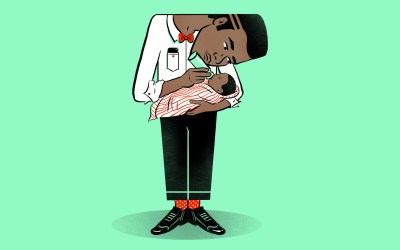
Original graphic via Jezebel

Other older marrieds sometimes ask me the secret to having a husband who does easily half, arguably more, of the childrearing and cleaning/cooking in our house. The secret is I married someone who is 33 years old. Good news for people like me: Millennial dudes are the most engaged, involved fathers in history. Bad news: Even they are having trouble knocking this equality thing out of the park.

Writing at the New York Times, Claire Cain Miller reports on the bummer reality that millennial fathers are giving it the old college try on the raising the kids and doing the dishes front, but finding themselves screwed when it comes to workplace policies that haven’t kept pace. Miller writes:

“The majority of young men and women say they would ideally like to equally share earning and caregiving with their spouse,” said Sarah Thébaud, a sociologist at the University of California, Santa Barbara. “But it’s pretty clear that we don’t have the kinds of policies and flexible work options that really facilitate egalitarian relationships.”

Work-family policies strongly affected women’s choices, but not men’s. Ms. Thébaud said that occurred because women disproportionately benefit from the policies since they are expected to be caregivers, while men are stigmatized for using them.

The word “benefit” here is dubious. It’s more complicated than this, because when women take advantage of these so-called favorable conditions designed precisely for them, yes, they are, in effect benefiting. But it’s not as if exercising the option doesn’t come with a penalty, it just kicks in before they ever get pregnant—in the form of being regarded as less reliable from the start, and therefore missing leadership roles or promotions due to the expectation they will start a family—and then they’re hit again afterward, when they find it difficult to re-enter the workforce after going part time. Meanwhile, men are viewed as more reliable after a family, not less.

Thébaud’s work comes from a study she co-authored on workplace policies and their effect on millennial relationships, the first such large study of its kind. But Miller cites other research that found the same thing again and again: People increasingly want and expect equal relationships, only to find that the world doesn’t seem to want to yield, in part because the nature of work has become never-ending, with everyone on the digital leash 24/7, and in part because of simply what happens when children come into the picture. One Families and Work Institute study Miller cites found that 35 percent of childlessmillennial men thought men and women should take on traditional roles, i.e., him the breadwinner, her the caregiver, while 53 percent of those with kids thought traditional was the best arrangement.
Here’s Miller:

“They say, ‘I didn’t realize how much of a ding it would be on my career,’” said Laura Sherbin, the center’s director of research. “It’s what women have been saying for years and years.”

The research shows that when something has to give in the work-life juggle, men and women respond differently. Women are more likely to use benefits like paid leave or flexible schedules, and in the absence of those policies, they cut back on work. Men work more.

But again, let’s note that both men and women who want equal partnerships are being penalized in some way or another for having families—women are penalized for being women, i.e., caregivers, while men are being penalized for not acting like men, i.e., breadwinners. Men will at least be rewarded through work after breeding—research shows men on average score a 6% raise per child, whereas a woman’s salary will decrease by 4 percent per child.

Other research Miller details that surveyed unmarried millennials about future work/family balance found that respondents overwhelmingly chose egalitarian arrangements (95 percent of college-educated women vs. 75 percent of college-educated men; 82 percent of women without college vs. 68 percent of men) when work policies supported them. But when they didn’t support them, things looked a little different.

Full story: Jezebel »
The More I Learn About Breast Milk, the More Amazed I Am

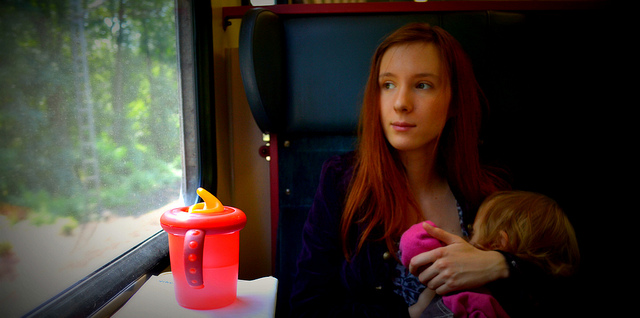
Photo: Maja via Flickr Creative Commons

To produce breast milk, mothers melt their own body fat. Are you with me? We literally dissolve parts of ourselves, starting with gluteal-femoral fat, aka our butts, and turn it into liquid to feed our babies.

Before and after giving birth to my daughter 10 months ago, I was inundated with urgent directives from well-meaning, very insistent health practitioners, parenting book authors, mommy bloggers, journalists, and opinionated strangers that “breast is best.” The message was clear: In order to be a good mom, I had to breast-feed.

But breast-feeding is more than being a good mom. And breast milk is much more than food: It’s potent medicine and, simultaneously, a powerful medium of communication between mothers and their babies. It’s astonishing. And it should be—the recipe for mother’s milk is one that female bodies have been developing for 300 million years.

Breast-feeding leads to better overall health outcomes for children, which is why the World Health Organization and the American Academy of Pediatrics recommend that babies be exclusively breast-fed for a minimum of six months.

Those outcomes, though, are relative: A premature infant in the neonatal intensive-care unit or a baby growing up in a rural African village with a high rate of infectious disease and no access to clean water will benefit significantly more from breast milk over artificial milk, called formula, than a healthy, full-term baby born in a modern Seattle hospital.

We’re also told that breast-feeding leads to babies with higher IQs and lower rates of childhood obesity than their formula-fed counterparts. I understand why people find this appealing, but I don’t plan to raise my daughter to understand intelligence in terms of a single test score, or to measure health and beauty by body mass index.

More compelling to me are the straightforward facts about breast milk: It contains all the vitamins and nutrients a baby needs in the first six months of life (breast-fed babies don’t even need to drink water, milk provides all the necessary hydration), and it has many germ- and disease-fighting substances that help protect a baby from illness. Oh, also: The nutritional and immunological components of breast milk change every day, according to the specific, individual needs of a baby. Yes, that’s right, and I will explain how it works in a minute. Not nearly enough information is provided by doctors, lactation counselors, or the internet about this mind-blowing characteristic of milk.

I made the choice to breast-feed around the same time I was offered a full-time job writing about food. Every morning at 7 a.m., I nurse my daughter. At the office, I pump milk two times a day. When I come home, we nurse, and then at 7 p.m., we nurse before she goes to bed. A few nights a week, I go out to dinner for work.

For six months straight, I woke up every night at 3 a.m. and pumped milk for half an hour in order keep my supply ahead of her demand. (Three a.m. is possibly the darkest, loneliest, and most quiet hour of the night, but I had the reassuring, rhythmic sound of my pale-yellow breast pump to keep me company.) For the last 10 months, there hasn’t been one minute of my life when I wasn’t thinking about, writing about, eating, and/or producing food.

Food points to who we are as animals—human beings with a fundamental need for nourishment, survival—but also to who we are as people: individuals with families, histories, stories, idiosyncrasies. Every day, calories, vitamins, and even clues about the culture I live in flow, drip, leak, and squirt out of my boobs, staining my clothes and making my skin sticky. And every day, I wonder what exactly goes into this miraculous substance.

“People tend to underestimate what milk is,” says Katie Hinde, a biologist and associate professor at the Center for Evolution and Medicine at the School of Human Evolution & Social Change at Arizona State University. She also runs the very funny, highly informative, and deeply nerdy blog Mammals Suck… Milk!

“That’s in part because you go to the store and there’s an entire aisle dedicated to buying milk that is literally a homogenized, standardized food. It leads us to take mother’s milk for granted.”

But right now, researchers like Hinde—a mix of evolutionary biologists, dairy scientists, microbiologists, anthropologists, and food chemists—are examining milk, and the more closely they look, the more complexities they find.

Full story: The Stranger »

New survey yields insights into Seattle employees’ experiences with sick and safe leave law

Space_Needle_cropped[Cross posted from EOI] To gain additional insight into the extent to which lower wage workers in Seattle are aware of the sick leave law and have access to paid sick leave, the Economic Opportunity Institute conducted a survey in partnership with the YWCA Seattle|King|Snohomish in the spring of 2015.

One standout finding: Life doesn’t happen in averages. Just under half (48%) of all respondents used no sick days in the past year — but among those who did (52%) usage varied from 1 to 6 days. This highlights the need for paid sick/safe leave policies that aren’t based on the notion workers will use some “average” number of days in a year.

Other findings:

  • The majority of respondents said their employer provided paid sick leave: 63% were aware that their employer provided paid sick leave, 20% said their employer did not provide paid sick leave, and others were unsure or did not respond to the question.
  • Women respondents were more likely to use sick leave than men, both for themselves and family care. Whites were more likely than Black, Latino, and Asian respondents to use leave.
  • Workers with higher incomes were far more likely to have access to and have used paid sick days, and much less likely to face retaliation, than the lowest income workers. Women were twice as likely as men to have been punished for calling in sick.

Altogether, 83 people who had worked in Seattle during the preceding year participated. The responses to this survey provide insight into how widely Seattle’s sick leave law is being followed, but are not statistically valid for all Seattle workers.

Read the full issue brief here »