Brendon Schrader, founder of Antenna, a Minneapolis-based firm that delivers experienced marketing professionals to companies of all sizes.
[Via Forbes.com] For many years, when we talked about “workplace flexibility” or “flex time,” most people really only thought it applied to working mothers. But workplace flexibility has always been something fathers value, too. And the conversation about flexible work is becoming more and more gender-inclusive.
A flexible workplace has always been important to me: early in my career as an aspiring professional, then a corporate employee, and now as a father and entrepreneur. When I worked as a corporate marketer inside a Fortune 500 company, I felt constrained by the traditional work structure and how flexibility was perceived by the organization. Ten years ago, true flexibility just wasn’t accepted. I built my own firm partly to create more flexibility for myself and others who want the same things.
In late 2015, Facebook founder Mark Zuckerberg announced he’d be taking two months of parental leave following the birth of his first child and expanded the company’s parental leave policy to grant four months of paid leave to all full-time workers (male or female). Although some companies are making stridesto support flex time for all employees, men’s desire and need for flexibility still typically receives little attention from the traditional organization.
Women and men clearly need more flexibility: In a survey by the Pew Research Center, 50 percent of working fathers said it was very or somewhat difficult to balance the responsibilities of their jobs and their families. In my view, we need to include both men and women in the conversation about work flexibility in order to expand this issue and create supportive, positive workplaces for every employee and family.
Columnist Noe Felix, staff writer, Sonoma State Star
America has always prided itself on being a country founded on family morals. Common wisdom seems to dictate that we’re supposed to always put our families above all.
However, when one is starting a family in the United States, that can be more than difficult. The U.S. doesn’t make any effort to help people start families.
Starting a family is especially taxing on men because of the lack of a good paid paternity leave programs. While women are given some paid maternity leave, at a rate that varies from state to state, men are given less opportunities to be with their newborns in the first few months of their lives.
It’s appalling we put more emphasis on men being the main breadwinners, instead of being actual fathers.
According to a study by the Center for Work and Family at Boston College, dads rarely take time off after the birth of their child. In fact, the same study goes on to report that three quarters of men who don’t receive a form of paternity leave take off a week at work. What’s even more shocking is 16 percent of them are unable to take any days off.
What kind of country are we living in if we can’t offer more than a measly week off with pay? Moreover, how must a new father feel if they can’t take any days off from work?
[Original: Economic Opportunity Institute] From high-profile CEOs and movie stars to healthcare and retail workers, men consistently make more than women. Social scientists and economists have found clear evidence that gender-based discrimination persists – and is so deeply ingrained in culture and practice that it often goes unrecognized. Ensuring that all employees have the right to discuss and ask about pay and job opportunities, and that anti-discrimination laws are effectively enforced, will benefit women, families, businesses, and our state economy.
What’s the wage gap?
More than seventy years after Washington State banned paying women less for similar work, women’s pay still trails significantly behind men’s. Women make up half of the workforce and are either the sole or primary breadwinners in over 40% of families with children nationally.[i] Yet, the typical Washington woman who worked full-time, year-round in 2014 took home only 77 cents for every $1.00 made by a man.[ii]
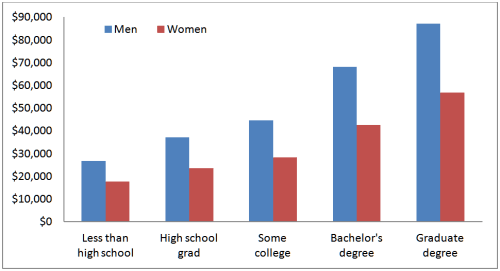
Washington women who worked full-time in 2014 were paid $13,000 less than men, diminishing family budgets and undercutting community business prosperity. Women of color face especially large wage disparities. Median pay for White women in Washington is 74% of White men’s, for Black women 68%, and Latinas 48%. The wage gap persists at all education levels and across occupations. More women than men between the ages of 25 and 45 hold four-year college degrees in Washington, but women need those degrees to make the same amount of income as men with less formal schooling.[iii]
Median Earnings by Education Level, Washington 2014, for population over age 25 with earnings
Source: U.S. Census Bureau, 2014 American Community Survey
Extra months women must work to equal White men’s annual pay for full-time, year-round workers, Washington, 2014
Source: U.S. Census Bureau, 2014 American Community Survey
Why is there a wage gap?
Occupational segregation and devaluing “women’s work”: Continued occupational segregation and the lower value society assigns to “women’s work” explain a big part of the wage gap. Men hold 4 in 5 jobs in highly paid engineering and computer-related fields, and 3 in 4 jobs in aerospace manufacturing. Childcare teachers – mostly women – get paid less than male roof helpers. Secretaries and dental assistants make less than auto body repairers and truck drivers.[iv]
Median Annual Pay by Sex and Occupation, Full-Time, Year Round Workers, Washington, 2014
Source: U.S. Census Bureau, 2014 American Community Survey
Segregation persists and men’s jobs pay more within occupational categories. Men hold more retail sales jobs in hardware stores, while women predominate in clothing stores.[v] In groceries, men dominate as meat cutters and make more than deli workers – who are mostly women.[vi]
Time out for family care: The “wage gap” usually is calculated using only figures for full-time, year-round workers. It becomes even larger when we consider that women are more likely than men to work part-time and to take time out of the workforce for family care. In Washington, women make up 47% of the full workforce, but hold only 41% of full-time, year-round jobs.[vii] If women scale back to make time for family for any part of their careers, they often lose even more in seniority, opportunities for promotion, lifetime pay, and retirement income.
Motherhood penalty: On average, mothers make lower wages than women without children, even after qualifications and hours worked are taken into account.[viii] Studies have shown that employers are less likely to hire women with children than either childless women or fathers, regardless of education and experience.[ix] A study of 200 managers at Fortune 100 companies found that they tended to assume that women employees had more difficulty balancing work and family than men, even though the women themselves reported less conflict. That bias resulted in the managers being less willing to promote women.[x] Harvard economists found that professional women who took maternity leave made less than their male counterparts who took similar paternity leaves: a gap of 41% for those with MBA degrees, 29% for lawyers, and 33% for female PhD’s.[xi]
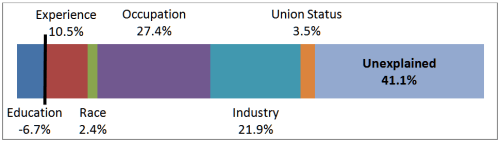
Discrimination: Economists have found that up to 40% of the wage gap cannot be explained by differences in occupation, industry, union membership, education, or experience.[xii] At least part of this wage gap is related to discrimination. Women are offered lower compensation than men when first hired, even if education and experience levels are similar, and they receive smaller and less frequent promotions.[xiii]
Factors contributing to the Gender Wage Gap
Source: Blau & Kahn, “The Gender Pay Gap,” Academy of Management, Perspectives, 2007
Why existing laws aren’t enough
Washington State passed an Equal Pay Act in 1943 during World War II, when many women were performing traditionally male jobs. That law prohibits paying women less than men in similar work or in jobs formerly held by men. But to pursue a discrimination claim under this law, a woman would have to sue her employer in court and could only recover lost wages, not court costs or attorney fees.
Both Washington State and the federal government have passed additional anti-discrimination laws that protect people in a number of categories, including gender, race, disability or veteran status. Under these laws, however, women must prove intentional discrimination. Courts have allowed employers wide latitude in justifying paying women less than men, including giving men and women different job titles for similar work. Employers may even claim there was no reason they paid a man more, but they did not intend to discriminate.[xiv]
Many women never find out they are being paid less due to pay secrecy. While salary information is usually openly available in public sector jobs, one third of private firms admit in national surveys to actively discouraging or prohibiting employees from discussing their pay with other employees.[xv] Among employees, over 60% of private sector workers reported in a 2010 survey that they were discouraged or prohibited from discussing pay.[xvi]
Modernizing state law: The Washington Equal Pay Opportunity Act
No single policy will close the gender pay gap, but greater wage transparency will provide everyone with more opportunity to gain equal wages, open new career opportunities for more women, and begin to challenge society’s general undervaluing of women’s work. House Bill 1646 passed Washington’s House in both 2015 and 2016 with bipartisan support, but did not pass out of committee in the Republican-controlled Senate.[xvii]
Washington needs an Equal Pay and Opportunity Act that will:
Protect the rights of all workers to discuss or ask about compensation, and prohibit retaliation against employees who do so. This will enable workers to find out if others are paid more for the same work.
Protect the right of workers to ask why they are being paid less, or why they do not have the same access to job or career opportunities as others.
Authorize the Washington Department of Labor and Industries to investigate charges of gender discrimination so workers aren’t forced to go to court – and require employers being investigated to justify differences in pay & opportunity with job-related reasons, such as education, skills, or experience.
Pushing to the next level
Family-friendly workplace policies such as paid sick days, family and medical leave insurance, and reasonable accommodations for pregnant and breastfeeding women – along with more public funding for early learning and child care – will also boost family budgets and women’s lifetime incomes. Local businesses will benefit, and our economy and communities will be stronger, when women have the opportunity to achieve equal pay.




 Washington Work and Family Coalition