
This Is What Parental Leave Really Looks Like In America

shuller family photoAmerica is facing a national crisis. It is the only developed country in the world that doesn’t offer paid time off to new parents — and moms and dads are struggling.

The current national policy, the Family and Medical Leave Act, only offers parents 12 weeks of leave — but that’s unpaid, if the parents are even eligible. A handful of states have tried to compensate with their own paid leave laws, but with only four states nationwide that offer them so far, they’re the exception, not the rule.

As a result, families are at the behest of their workplace to determine how much time off they’ll get with their new baby, if any, before they have to go back to work. In a system that depends on employer generosity, the results leave much to be desired: Only 12 percent of private-sector workers have paid family leave.

When parents don’t have paid family leave, the outcomes are devastating: 1 in 4 working moms return to work less than two weeks after giving birth. They suffer higher rates of depression and stress, and their babies experience more health risks as they are breastfed less and brought to fewer medical appointments.

Families as a whole suffer without paid leave, as parents are forced to take unpaid time off to be with their new child, causing some families to fall into poverty.

The Huffington Post spoke to eight families across the country to see how they brought their babies into the world without assured paid time off. These are their stories »
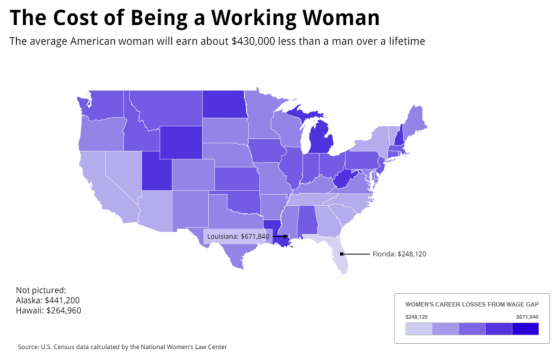
Being a Woman Will Cost You $430,480 Over Your Working Lifetime

What’s the individual damage from gender inequality in the workplace? For the average U.S. woman it’s more than $430,000 over the course of her career, according to an analysis by the National Women’s Law Center, a non-profit advocacy group.

cost of being a woman
Click to embiggen

The gender pay-gap issue has come to the fore following criticism from President Barack Obama that women earn 79 cents for every dollar a man makes and demands by actresses including Oscar winner Jennifer Lawrence and top women’s soccer players for equal wages to their male counterparts. Some states have intervened: California lawmakers last year approved legislation mandating that women and men earn the same amount for similar work.

“We’re in a moment where women are making up an increasing part of the workforce and there’s a firm recognition that their salaries matter to themselves, but also to their families’ economic security,” Fatima Goss Graves, a senior vice president at NWLC, said by phone. “We’ve seen very prominent figures call attention to the wage gap and that’s so critical because it highlights no industry is immune to it.”

For the working women in America, race is also a factor in pay disparity, and to a lesser extent where they live. The gap is widest for African-American and Latino women in the nation’s capital, Washington, where the gap is $1.6 million to $1.8 million over a four-decade career, compared with a white, non-Hispanic male wage-earner.

Full story: Bloomberg »

In a Historic Move, L.A. City Council Votes in Paid Sick Days Expansion

BREAKING NEWS: The Los Angeles City Council has voted to ensure LA workers not only have 6 paid sick days — but also (this part is great!) the right to use that paid sick time to care for family *whether related by blood or affinity*. This is the very first law to use this “gold standard” for a broad and inclusive definition of family. Congratulations LA and especially to all the people and organizations who have worked so hard for this win!

Read more »