Congrats on instituting Paycheck Fairness for women, New Hampshire!

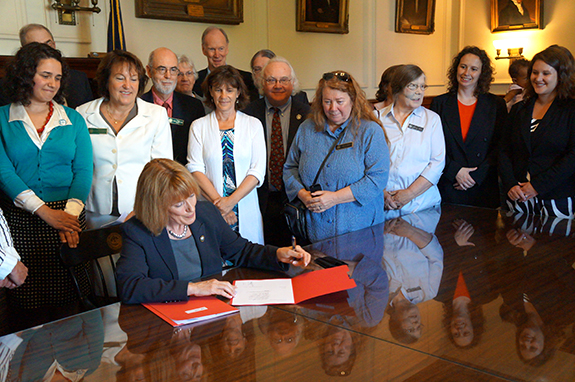
gov hassanIf you’re a woman in New Hampshire, things just got a little easier for you. Calling the Paycheck Fairness Act “the most significant piece of legislation for women in New Hampshire in over a decade,” the Granite State’s Governor Maggie Hassan held a ceremonial signing of the bill on July 22.

What is the Paycheck Fairness Act and how does it help address the wage gap for women? This legislation protects women when (not if) they experience pay discrimination. Currently, due to pay secrecy, many women never find out they are paid less than their male counterparts. Many private firms (one in three, according to one recent national study) admit to actively discouraging or prohibiting employees from discussing their pay with other employees.

To address the wage gap, the Paycheck Fairness Act:

  • Increases transparency in wages by prohibiting employers from retaliating against workers who discuss compensation and
  • Requires employers to justify differences in pay based on factors not related to race or gender

Just how bad is the wage gap? More than fifty years after the passage of the  Equal Pay Act, for every $1.00 earned by the average white male, the average woman earns only 77 cents-and the wage gap is even worse for women of color.  Black women earn 64 cents and Latina women earn 54 cents for every dollar earned by the average white male. Women earn less than their male counterparts across all occupations and sectors-even though women earn more college degrees than men and make up almost half of the workforce. Economists have found that while differences such as education or occupation explain part of the wage gap, up to 40% cannot be explained by differences in occupation, industry, union membership, education or experience.

At least part of this ‘unexplained’ wage gap is related to discrimination. Women are often offered lower compensation than men when they are first hired, even if education and experience levels are similar, and receive smaller and less frequent promotions. Studies have also shown that employers are less likely to hire women with children, regardless of education and experience.

statewide paycheck fairness lawsEven though Paycheck Fairness legislation has repeatedly stalled at the federal level, (most recently in April of this year,) states around the country are standing up for women. Nine states around the country-states like Minnesota, Colorado, and of course, our progressive neighbor to the south, California – all have Paycheck Fairness Acts on the books. New Hampshire is the newest state to join the club.

In Washington, a Paycheck Fairness Act is sorely needed for working women and families-and it’s a crucial piece of a broader agenda for women’s economic security. Read more in EOI’s recent publication on Washington State’s Work and Family Agenda.

As New Hampshire’s Governor Hassan boldly stated as she signed the Paycheck Fairness Act into law, “Ensuring that women and men can earn equal pay for an equal day’s work isn’t just an issue of fairness–it’s essential to our economic future.”

Via the Economic Opportunity Institute.

Happy 21st Birthday FMLA!

3808089294_8f01d519e6_oCongress improved working conditions for millions of women and families across the
nation when they passed the landmark Family Medical Leave Act (FMLA) twenty-one years ago. However, today millions of workers are still without access to paid leave and many are forced to choose between keeping their jobs and caring for a sick family member or themselves. In order to better meet the needs of today’s workers and businesses, Congress must act to expand FMLA.

By ensuring people would have job-protected leave for medical and care giving purposes, FMLA helped millions of workers meet the dual demands of job and family by caring for a new baby, an ailing family member, or their own health.

But while FMLA was a big step, the legislation still falls short of ensuring all working families have access to family and medical leave. FMLA does not cover companies with fewer than 50 employees – and it only guarantees unpaid leave, which millions of people cannot afford to take. The law does not provide for part-time workers, nor does it cover non-serious or habitual medical illnesses such as the flu. As a result, 40% of the workforce has no access to FMLA, or finds it very difficult to use the benefits provided by the law.

Following the doctor’s orders to stay home when sick shouldn’t mean losing needed family income or risking your job. The FMLA is a major success for working women and their families but more needs to be done to ensure our leave policies address the needs of a modern workforce.

The Washington Work and Family Coalition believes paid leave is a basic workplace right and we’re leading the fight for state-wide legislation to ensure all Washington workers have access to paid sick days and family and medical leave insurance.

It’s time to empower working families across our state to keep themselves and their kids healthy without risking their family economics. Join us at our upcoming Community Forums in Spokane, Vancouver and Bellingham to advance FAMLI (Family and Medical Leave Insurance) legislation and make paid leave a reality for all Washington families!

By Sarah Van Houten, MPAc Graduate Intern

Paid Parental Leave: The Status of Women 50 Years Later

logoFifty years ago the President’s Commission on the Status of Women recommended that paid maternity leave be provided to improve conditions for working women. While the 1993 Family Medical Leave Act (FMLA) was an important step in improving access to leave for new parents, the United States is still without a federal maternity or family leave statute. This month, the Women’s Bureau at the Department of Labor released a full paper series commemorating the 50th Anniversary of American Women: Report of the President’s Commission on the Status of Women. As part of this series, the Institute of Women’s Policy Research (IWPR) prepared a paper that reviews data on the benefits of paid parental leave from the perspectives of individuals, families, employers, and the economy overall.

The report found that paid family and medical leave programs can have significant benefits to individuals, to businesses, and communities.

Economic Benefits

  • Improved Labor Force Attachment:
    • Women who are offered paid leave are more likely to return to the labor force in the year after they give birth than women who are not offered paid leave. Additionally, paid leave has been shown to have a positive effect on post-birth work outcomes.
  • Costs and Benefits to Firms:
    • Paid leave leads to negligible costs to employers in terms of temporary employee replacement costs or overtime paid to existing employees and has much greater potential gains in terms of employee morale and productivity.
  • Expands Economic Growth:
    • Paid leave can lead to increased labor force participation, increased fertility rates, and reduced spending on public assistance. Family friendly policies can help push the economy towards gender equality in the labor force, therefore mitigating the effects of a shrinking, aging workforce and increasing GDP.

Health Benefits

  • Increases initiation and length of breastfeeding:
    • Breastfeeding can increase bonding between the child and nursing mother, stimulate positive neurological and psycho-social development, and strengthen a child’s immune system. Breastfeeding has also been shown to reduce the risk of health problems and disease.
  • Reduction in the risk for infant mortality
  • Increases well-baby care and vaccination rates
  • Improves mother’s emotional well-being and mental health
  • Maternity leave allows mothers to increase the quality of care given to her child and can help prevent postpartum depression and stress

Family benefits

  • Greater paternal engagement in caregiving:
    • Fathers who take time from work around childbirth are more likely to spend more time with their newborns, which could reduce stress on the family and contribute to father-infant bonding.

FMLA, which provides men and women with job-protected leave for a number of caregiving purposes, has provided many American workers with unpaid leave for moments when family had to come first. But the law falls short of what families really need: universal coverage and income.

To qualify for FMLA you must work for a company with at least 50 employees and have worked 1,250 hours in the past year. That means part-time workers and small business employees aren’t protected. And most working families can’t afford to take two months off of work without income forcing many to choose between caring for their family or providing for them.

According to the report, the U.S. is “the only high-income country, and one of only eight in the world, that does not mandate paid leave for mothers of newborns”. Moving forward, IWPR urges the U.S. to catch up to other developed nations and address today’s workforce realities for both mothers and fathers through more comprehensive legislation. A paid family leave and medical insurance law would help build a more productive workforce, promote economic competitiveness, and bring substantial health benefits to individuals, employers, and society.