We can’t talk about the pay gap without talking about race

We’re all aware of the statistic that American working women are paid 79 cents for every dollar that working men make. There’s a reason this disparity is so well-known — it’s a powerful indicator of the value, monetarily and socially, placed on men over women.

But this glimpse of the pay gap only tells a portion of the story. It becomes even more alarming when race is taken into account. The following chart, created by statistics portal Statista, shows how much the gender pay gaps widen when we consider race.
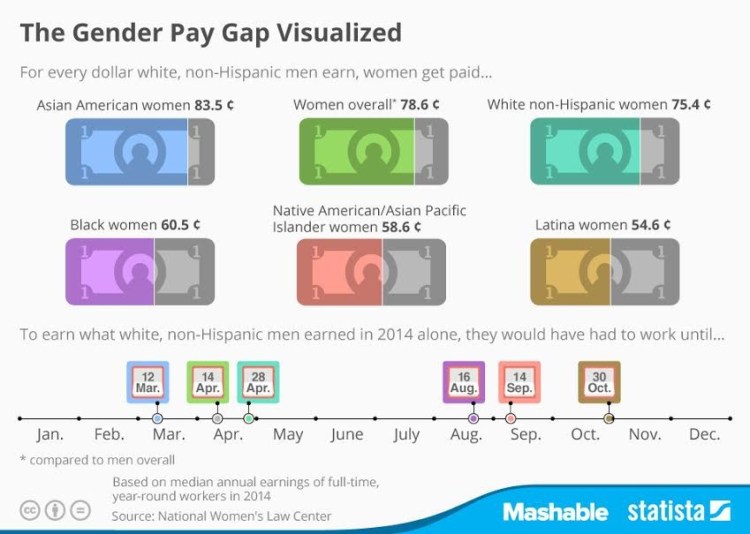
Latinas are the last racial group of women to catch up to the earnings of white, non-Hispanic men, affected longer than the average Asian, white, black and indigenous woman. And the overall gender pay gap is widening, even when race is pushed out of the picture.

Read more: Mashable.com »

What’s missing from Amazon’s new parental leave policy

dad office babyAmazon made a big announcement [in November] about parental leave. This comes after the firestorm following the New York Times article on Amazon’s office culture (including how unfriendly it was to new parents).

In an email message forwarded to Jezebel, Amazon is now going to offer up to 20 weeks of parental leave for birth mothers, and six weeks for all other new parents. The policy includes a new “leave-share” program aimed to help Amazon employees share their leave time with partners who may not have a leave policy at their workplace. There’s also a “ramp-back” program, which is designed help new parents transition back to work.

“One hopes that [Amazon’s policies] are about boosting morale,” Ellen Bravo, executive director of Family Values @ Work, tells Fast Company. The national network of 21 state and local coalitions aims to grow the movement for family-friendly work policies.

“All these policies are great,” says Bravo, especially the leave share, as it acknowledges that many partners need affordable leave but don’t get it. “You have to have a clear message from the top on paper,” she adds. But Bravo believes there’s something important missing from the announcement.

Full story: Fast Company »

Stressed, Tired, Rushed: A Portrait of the Modern Family

Jakub Zielkiewicz, Aimee Barnes and their 15-month-old son, Roman, at their home in Sacramento. “You basically just always feel like you’re doing a horrible job at everything,” Ms. Barnes said. Credit Jim Wilson/The New York Times

Children are much more likely than not to grow up in a household in which their parents work, and in nearly half of all two-parent families today, both parents work full time, a sharp increase from previous decades.

What hasn’t changed: the difficulty of balancing it all. Working parents say they feel stressed, tired, rushed and short on quality time with their children, friends, partners or hobbies, according to a new Pew Research Center survey.

he survey found something of a stress gap by race and education. College-educated parents and white parents were significantly more likely than other parents to say work-family balance is difficult.

The data are the latest to show that while family structure seems to have permanently changed, public policy, workplace structure and mores have not seemed to adjust to a norm in which both parents work.

“This is not an individual problem, it is a social problem,” said Mary Blair-Loy, a sociologist and the founding director of the Center for Research on Gender in the Professions at the University of California, San Diego. “This is creating a stress for working parents that is affecting life at home and for children, and we need a societal-wide response.”

Full story: New York Times »