Help your state legislators understand why paid sick and safe days matter

State lawmakers are studying paid sick and safe days bills - and they need to hear your stories!

UPDATED – 01/20/2012, 4:32 PM

Washington lawmakers are studying two Paid Sick and Safe Days bills during this legislative session (House Bill 2508 and Senate Bill 6229) – and they need to hear from you!

Please contact your legislators now to tell them why Paid Sick and Safe Days are important for you and your family’s health and economic security.

And if you’re able, come down to Olympia to show your support for the legislation at these committee hearings:

  • Tues, Jan 24, 1:30-3:30 pm, Cherburg Senate Hearing Room 4: Labor, Commerce & Consumer Protection Committee
  • Wed, Jan 25, 1:30 -3:30 pm, Joint Legislative Office Building, House Hearing Rm C: Labor and Workforce Development Committee

You can learn more about the proposed legislation in this handy overview.

Posted in Paid Family Leave, Paid Sick Days, Washington | Tagged , , , , , , , | Leave a comment

Washington state Legislature introduces Paid Sick Days bills

Last week, HB 2508 and SB 6229 were introduced in Washington’s legislature by a group of 18 legislators from the House and Senate. These bills would establish minimum standards for paid sick and safe leave for workers across the state of Washington – similar to a standard adopted by the Seattle City Council in September 2011.

The Washington Family Leave Coalition will be working with legislators on the Paid Sick and Safe Leave bills in the coming weeks – but we need your help. Public hearings on the bills will be held in late Januray, and we need people who can share personal testimony about importance of paid sick days for working people and families.

If you can help, please contact Marilyn Watkins.

Posted in Paid Sick Days, Washington | Tagged , , , | Leave a comment

Crain’s NY: Retail workers struggle to make ends meet

Crain’s New York Business has the story on a new study of retail workers struggling to make ends meet in New York City.

The report, titled “Discounted Jobs: How Retailers Sell Workers Short,” surveyed 436 workers in jobs across the five boroughs, making it one of the most comprehensive studies to date on the industry’s workforce in New York.

It found retail workers are often paid poverty-level wages, rarely receive benefits, lack paid sick days, and many are forced to rely on government programs.

Some of the highlights findings:

A third of New York City retail workers support families on less than $10 an hour, and more than half rely on government programs for health care or simply live without it.

Nearly one-third of those surveyed supported at least one additional family member on their wages; their median income was $9.50 an hour.

Typically, retail has been considered an entry-level job, focused on younger employees or women who are also juggling family-raising duties. But more than 70% of surveyed workers had completed some college or possessed a college degree.

Read the full story from Crain’s New York Business: Retail workers struggle to make ends meet »

Posted in In The News | Tagged , , | Leave a comment

The Cost of Not Taking a Sick Day

From The Atlantic:

Your nose is running, your throat is scratchy, and your eyes are burning. But you drag yourself out of bed, dress, and head to the office anyway feeling virtuous and sick. Once there, you proceed to share your virus with your coworkers. But at least you showed up to get the job done, right?

Wrong, according to a new study. Presenteeism — attending work while ill — is not always a smart choice for individuals or the organizations for which they work. It is entirely possible that a worker who is ill may be present physically, but mentally he or she might as well be home in bed.

A flu or cold virus or other illness spreading among coworkers can mean the loss of more than one employee’s productivity. It can paralyze entire departments. The study found that certain organizational cultures tend to promote presenteeism, or at least discourage absenteeism.

For the study, Gary Johns, a management professor at Concordia’s John Molson School of Business surveyed 444 people, asking about their job requirements, work experience, the numbers of days they had been out sick (absenteeism), and the number of days they had come to work feeling ill (presenteeism).

Read more from The Atlantic: The Cost of Not Taking a Sick Day »

Posted in In The News, Paid Sick Days | Tagged , | Leave a comment

Statewide Paid Sick Days bill to be introduced this week!

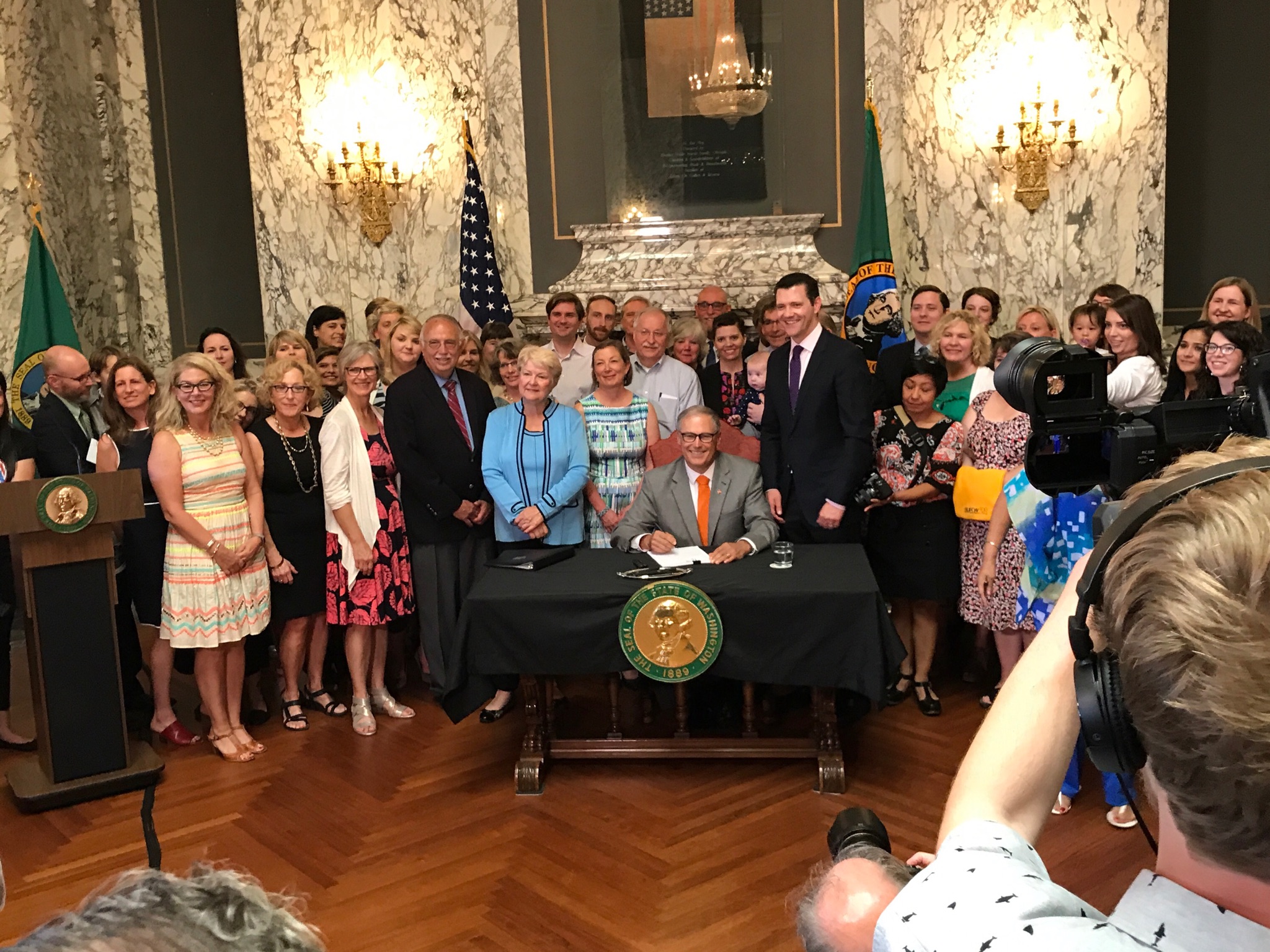
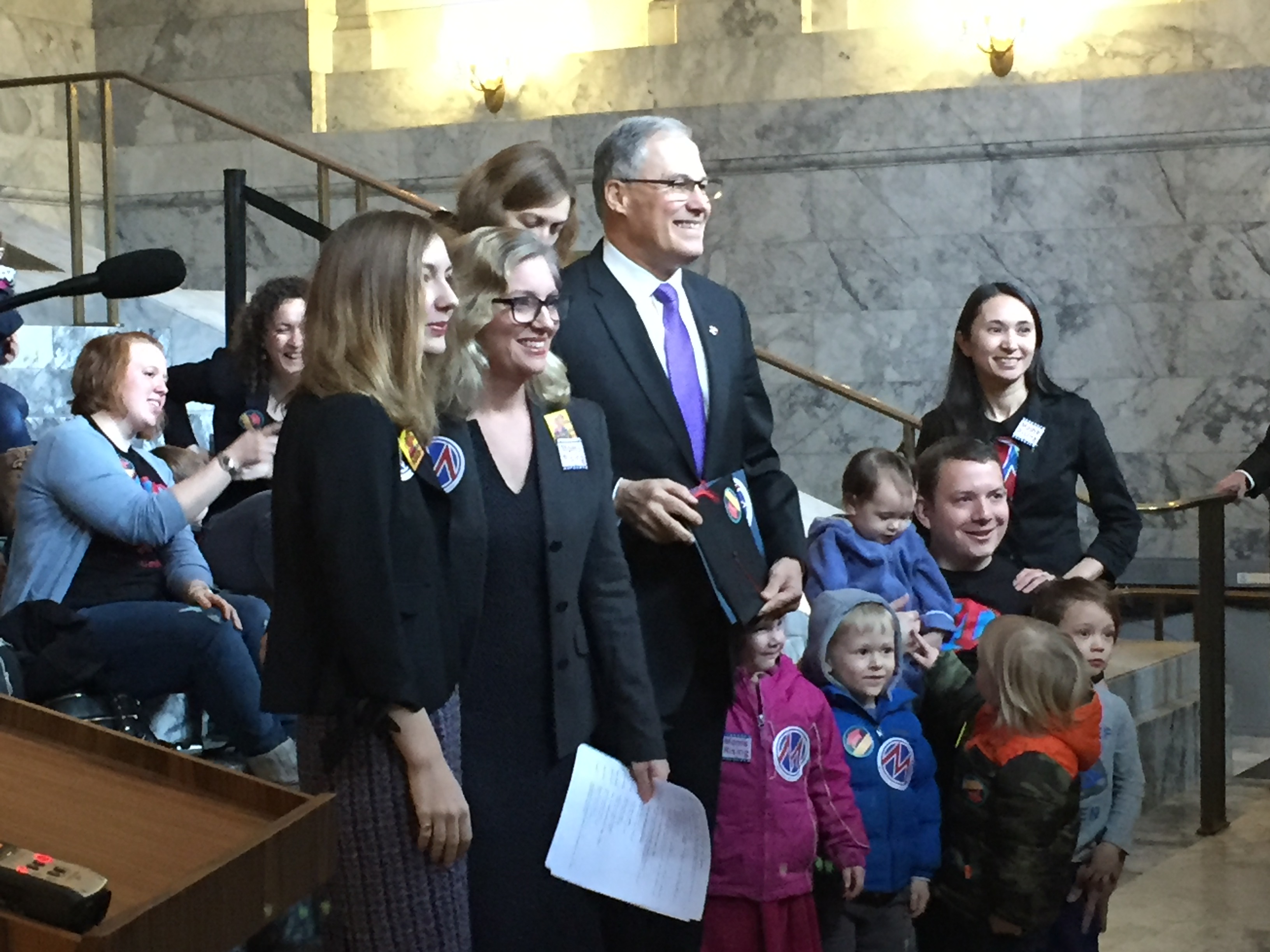
Seattle Mayor Mike McGinn signs the Paid Sick and Safe Leave ordinancePicture: Jen Nance

The upcoming 60-day legislative session will be a difficult one, but there’s something to look forward to: the introduction of a statewide paid sick days bill!

The Washington Family Leave Coalition been working with several legislators who want to build on the success of Seattle’s recent Paid Sick Days ordinance. They plan to introduce companion bills in the state House and Senate this week to ensure all workers in Washington can earn paid sick days while on the job.

We’ll post the bill numbers and key dates as soon as they’re made available – so check back in the coming days (or Like us on Facebook) for more information.

We need your help: Public hearings on the paid sick days bills will be held later in January, and we need people who can share personal testimony about importance of paid sick days for working people and families. If you’re interested, please contact Marilyn Watkins.

Posted in Paid Sick Days, Washington | Tagged , , | Leave a comment

Should Paid Sick Days Be Required by Law?

Via Time: Ideas | By Adam Cohen

Connecticut just became the first state in the nation to require employers to provide workers with paid sick days. The new law — which also allows paid leave for a sick child or spouse — is controversial. Opponents attack it as big government run amok and say it will kill jobs. But it is the right thing to do, both as a matter of humane treatment of workers and public health. And while the law doesn’t cover everyone, it’s a step in the right direction and other states should follow Connecticut’s lead.

Millions of Americans work at jobs that do not offer them a paid day off when they get sick. In the private sector, nearly 40% of workers do not have paid sick leave. Not surprisingly, low-income workers are worst off. Among the bottom 25% of wage earners — those making $10.50 or less an hour — just 33% can take a paid day off when they are ailing.

That means that millions of Americans often have to go to work sick or in pain — a phenomenon known as presenteeism — or they may not be able to help family members who face medical emergencies. If they have no choice but to miss work, they risk being fired.

Advocates for paid sick leave point to the case of Hilda Pizarro. Pizzaro says she was suspended from her job cleaning houses for Merry Maids — which does not offer paid sick days — because she had to take her 2-year-old son to the hospital for emergency asthma treatment. While she was on suspension, she says, she was terminated.

Supporters of paid sick leave also argue that everyone benefits when sick people do not show up for work. Requiring paid sick leave “is good public policy and specifically good public health,” Governor Dan Malloy said when he signed Connecticut’s law last July. “Why would you want to eat food from a sick restaurant cook? Or have your children taken care of by a sick day-care worker? The simple answer is — you wouldn’t.”

Read more from Time: Should Paid Sick Days Be Required by Law?

Posted in Paid Family Leave, Paid Sick Days | Tagged , | Leave a comment

Sweet Victories: Lessons for 2012

From The Nation | By Katrina vanden Heuvel:

As we head into 2012, there are a lot of questions about where the Occupy energy will go from here. I’m confident it will move in powerful directions–fighting unjust foreclosures and evictions, exploring alternative banking, taking on outrageous student debt, countering the corrosive role of corporate money in politics, and allying in new ways with the growing ranks of poor Americans.

But there are also tangible—maybe not sexy or systemic—reforms that make a real difference in people’s lives and speak to OWS principles, and would benefit from its energy and activism. In 2011, two victories on paid sick leave offer something to build on as we work towards an economy that is more just and fair. Connecticut became the first state to guarantee this common sense protection for working people; and Seattle joined San Francisco and Washington, DC as the only cities with paid sick leave on the books.

As of New Year’s Day, hundreds of thousands of workers in Connecticut no longer have to choose between a paycheck, a job and taking care of a sick child or themselves; and on September 1, when the Seattle law takes effect, an estimated 150,000 workers who didn’t have paid sick days will begin to accrue them—thousands more will earn additional paid sick leave and have the flexibility and protection to actually use it. With more than 40 million workers in the US lacking a single paid sick day—and low-wage, women and Latino workers disproportionately affected—these new laws will also offer more evidence that this humane, decent approach to the workplace is also good for business. That’s important as more states and municipalities look to pass similar legislation.

What makes me angry is that paid sick leave is treated as a left versus right issue, when it’ s really about right versus wrong, and common sense. That was something organizers seized on as they pushed the Seattle bill.

Continue reading

Posted in In The News, Paid Sick Days, Washington | Tagged , , , | Leave a comment